Can Losing Weight Cure Sleep Apnea? What the Research Says
Can losing weight cure sleep apnea? Learn what the research says, how much weight loss helps, and why durable results are key to lasting relief.

Global leader in endoscopic weight loss, Triple-board-certified in obesity
If you’ve been told that losing weight could help your sleep apnea, you already know the feeling that comes with that conversation. The mix of hope and something harder to name. The unspoken part: I know. I’ve tried.
The science is genuinely on your side. Meaningful, sustained weight loss is one of the most powerful tools available to reduce or even eliminate obstructive sleep apnea. Some people get to put their CPAP away for good. Here’s what the research actually shows: how much weight loss it takes to see results, when full remission is possible, and what makes weight loss stick long enough for sleep apnea to stay gone.
The Link Between Obesity and Sleep Apnea
Obstructive sleep apnea occurs when the soft tissues in your airway collapse during sleep, temporarily blocking airflow. Repeated episodes fragment your sleep, strain your cardiovascular system, and leave you exhausted, no matter how many hours you spend in bed.
Excess weight is the single most modifiable risk factor for OSA. Fat deposits around the neck, throat, and upper chest narrow the airway and make it more prone to collapse. According to research from the Wisconsin Sleep Cohort Study, excess weight (BMI of 25 or higher) is attributable to 41% of mild-or-worse sleep-disordered breathing cases in adults, and 58% of moderate-to-severe cases. Reduce fat around the airway, reduce obstruction, and reduce apnea events.
Dr. Atul Malhotra, MD, sleep medicine specialist at UC San Diego Health and lead investigator of the SURMOUNT-OSA trials, has described obesity as the single most reversible risk factor for sleep apnea, noting that weight loss consistently improves OSA outcomes in patients with obesity.
How doctors measure sleep apnea severity
Severity is tracked using the apnea-hypopnea index (AHI), the number of breathing interruptions per hour recorded during a sleep study.
- Normal: fewer than 5 events per hour
- Mild OSA: 5-14 events per hour
- Moderate OSA: 15-30 events per hour
- Severe OSA: more than 30 events per hour
This is the benchmark used to diagnose OSA, track improvement, and confirm remission.
Can Losing Weight Cure Sleep Apnea?
For obesity-related OSA, yes. Meaningful, sustained weight loss can lead to full remission, defined as an AHI consistently below 5 without CPAP. It doesn’t happen for everyone, but the evidence is strong enough to consider weight loss a frontline treatment strategy, not just a lifestyle recommendation.
The landmark Sleep AHEAD study, the longest randomized controlled trial to date on lifestyle weight loss and OSA, followed adults with obesity and type 2 diabetes for 10 years. Participants in the intensive weight-loss group saw their AHI reduced by 9.7 events per hour compared with controls at 1 year, with improvements still measurable a decade later. At 10 years, OSA remission was more common in the weight-loss group (34.4%) than in the control group (22.2%). AHI decreased by approximately 0.68 events per hour for every kilogram lost.
What counts as remission?
OSA remission means your AHI has returned below 5 events per hour without CPAP. A follow-up sleep study is required to confirm it, and your sleep specialist should be involved before you consider stopping any treatment. According to a 2024 review of obesity-related sleep apnea remission, remission is most achievable when OSA was primarily driven by excess weight rather than anatomy or neurology.
How much weight loss do you need?
- 5-10% total body weight loss: Noticeable symptom reduction. You may snore less, wake up fewer times, and feel more rested in the morning.
- 10-15% total body weight loss: Significant AHI improvement, measurable at a follow-up sleep study. Many patients find they sleep more deeply and wake with less fatigue.
- 15-20%+ total body weight loss: Associated with OSA remission in eligible patients. For some, this is the point where CPAP use becomes optional — confirmed by a sleep specialist.
Research from the Wisconsin Sleep Cohort Study found that a 10% reduction in body weight is associated with approximately a 26% decrease in AHI. A systematic meta-analysis found that a 20% reduction in BMI was associated with a 57% drop in AHI.
.BYYTSjWn_22dqXI.png)
“The more weight you lose, the more your sleep apnea improves.” — Dr. Atul Malhotra, MD.(Source: TCTMD, 2024)
Wondering if you’re a candidate for this level of weight loss? See whether ESG Stomach Tightening® is right for you →
When Weight Loss Alone May Not Be Enough
Weight loss is most effective for obesity-driven OSA, but it doesn’t resolve every case. Three scenarios where it may not fully eliminate sleep apnea:
Anatomical causes. A small jaw, enlarged tonsils, a deviated septum, or a structurally narrow airway don’t change with weight loss. AHI may still improve, but full remission is less likely.
Central sleep apnea (CSA). CSA involves a breakdown in the brain’s signaling to the breathing muscles, not a physical blockage. Weight loss doesn’t address that neurological issue.
Mixed apnea. Some people have both obstructive and central components. Weight loss can help with the obstructive component, but the central component requires separate management.
Keep working with your sleep specialist as you pursue weight loss, and track progress through follow-up sleep studies.
Why Durability Is the Real Deciding Factor
Here’s what the Sleep AHEAD 10-year data makes clear: AHI improvement tracked directly with how much weight was maintained over time, not just how much was lost at peak. When weight comes back, so does the apnea. A diet that produces real weight loss, followed by regain, offers only temporary relief. That’s not a failure of effort. It’s a limitation of the method.
This is why how you lose weight matters just as much as how much you lose.
The case for a durable weight loss solution
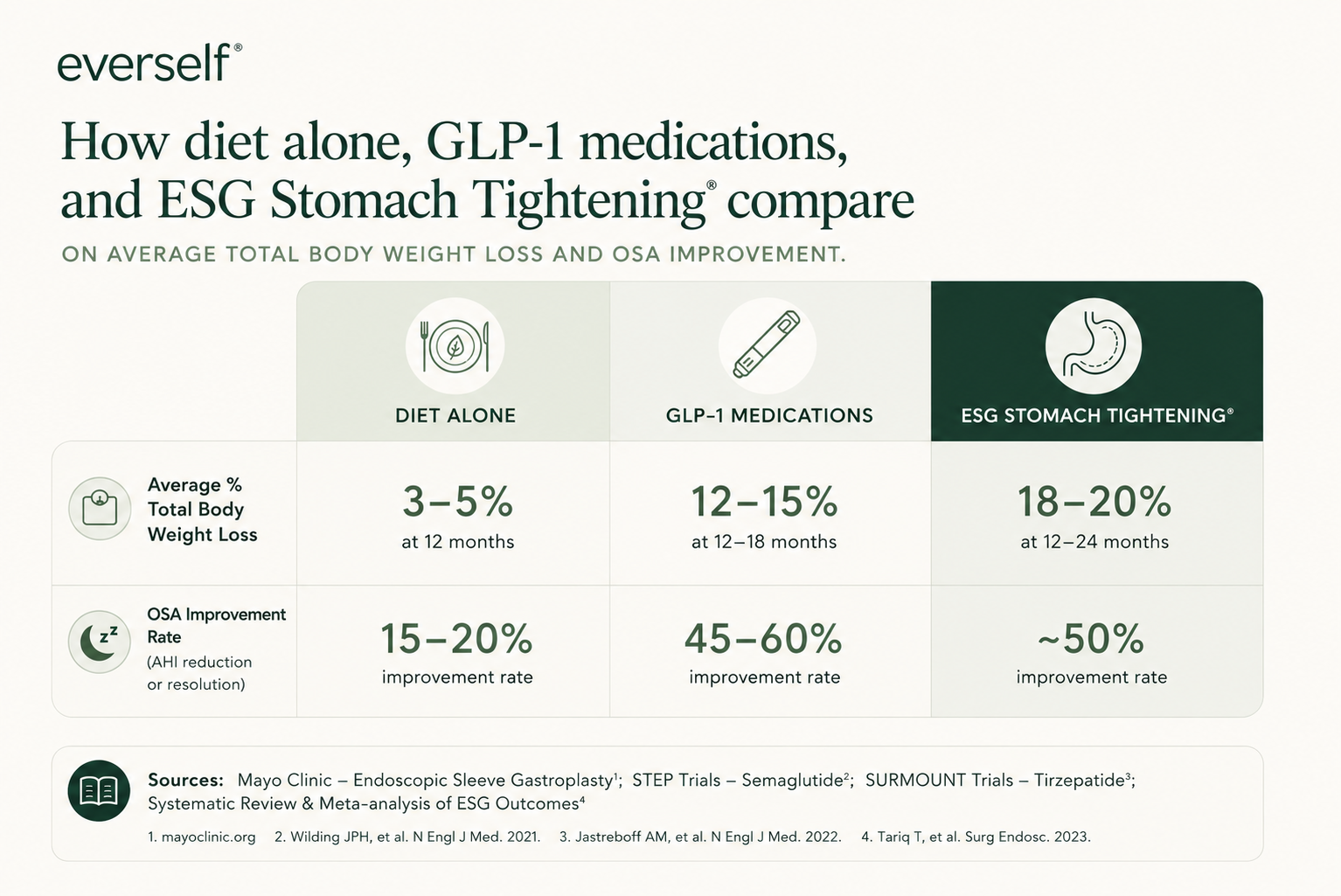
If 15-20% total body weight loss is the threshold associated with OSA remission, the question is: what’s the most reliable way to reach it and stay there? Diet alone is difficult to maintain long-term without structural support. You should explore the benefits of non-surgical weight loss procedures.
GLP-1 medications can be effective, but most of the weight returns once they’re stopped. A review comparing weight-loss strategies and OSA outcomes confirms that the durability of weight loss is the primary driver of sustained improvement in sleep apnea across all approaches.
Everself’s ESG Stomach Tightening® procedure takes a different approach. Pioneered at Harvard Medical School and FDA-authorized, it’s a one-time, non-surgical, incision-free endoscopic procedure that reduces the stomach’s functional volume from the inside. No scars, no overnight hospital stay, and typically a 2-3 day recovery. On average, patients achieve 15-20% of total body weight loss, which is exactly the range associated with meaningful OSA improvement.
The outcomes data back it up. A study in Obesity Surgery following 1,377 ESG patients for up to 6 years found that 89.9% of patients with obstructive sleep apnea saw remission or significant improvement. On durability, a 10-year outcomes study presented at ACG 2024 (Lahooti & Sharaiha, Weill Cornell, n=110) found that patients maintained meaningful weight loss a full decade after ESG, with 42% sustaining at least 10% total body weight loss without additional medication.
The 12-month Everself Program combines the procedure with ongoing support from a registered dietitian, regular nurse practitioner check-ins, and structured habit coaching to help maintain long-term results. Since this is one of the least invasive weight-loss procedures, it may also make it easier to stay committed to your goals.
Other Benefits of Weight Loss Beyond Sleep Apnea
Sleep apnea is rarely the only health issue linked to excess weight, and the same 15-20% threshold that drives OSA improvement also tends to move the needle on other obesity-related conditions. In the same 2026 ESG study cited above, patients at 6 years saw resolution or improvement in type 2 diabetes (51%), hypertension (66%), and dyslipidemia (74%), alongside a 90% improvement in OSA. Joint pain, daily energy, and cardiovascular markers tend to track in the same direction. The goal isn’t a number on a scale. It’s giving your body the conditions it needs to function well.
Conclusion
Weight loss can cure sleep apnea. That’s not false hope. It’s what the research consistently shows for patients whose OSA is driven by obesity. But the keyword is can, and the key condition is sustained.
Whether the right next step is a medically supervised program, medication, or a one-time procedure like ESG Stomach Tightening® depends on your health picture and your goals. What matters is that real options exist, and you don’t have to keep living the way you’ve been living. For more context on your options, explore the pros and cons of ESG weight loss
If you’re ready to explore a non-surgical route to lasting weight loss — and the better sleep that can come with it — schedule a consultation with Everself today →
“Nothing is easy, but with this level of care and commitment, you’re set up for nothing but success. ESG has changed my whole lifestyle; you can do it too!” — Helen, Everself ESG Stomach Tightening® patient.
Frequently Asked Questions
How quickly does sleep apnea improve with weight loss?
Many patients notice early improvements in snoring and daytime fatigue with as little as 5-10% body weight loss. Measurable changes in AHI are typically confirmed through a follow-up sleep study at around 3-6 months.
Can I stop using my CPAP if I lose weight?
Only with guidance from your sleep specialist, and only after a follow-up sleep study confirms your AHI has normalized. Never stop CPAP on your own based on how you feel.
Does the type of weight loss method matter?
Yes, significantly. Diet-only approaches frequently lead to regain, which reverses OSA improvements. Procedures like ESG Stomach Tightening® provide structural, long-term restriction with more durable outcomes, which is why method matters as much as amount.
Is ESG covered for patients with sleep apnea?
Coverage varies by plan and clinical profile. The Everself team can walk you through your options during a consultation. Book a free consultation here →
What about bariatric surgery for sleep apnea?
Traditional surgical options are also associated with significant improvements in OSA. The bariatric surgery for sleep apnea guide covers the comparison in detail, including how non-surgical procedures like ESG measure up.