Gastric Balloon vs. Gastric Sleeve: Key Differences Explained
Gastric balloon or gastric sleeve - which fits your goals? Compare weight loss, recovery, risks, and costs, plus a non-surgical option worth knowing.

Global leader in endoscopic weight loss, Triple-board-certified in obesity
If you’re researching weight loss procedures, your body isn’t failing you. You’re doing exactly what a careful, informed person does: comparing real options before making a decision that affects your health and your life.
You’ve narrowed your weight loss research down to two procedures: the gastric balloon and the gastric sleeve. One is temporary and non-surgical. The other is permanent and surgical. Both promise weight loss. Neither feels like an obvious choice.
If you’re stuck between them, you’re not alone. Most people researching gastric balloon vs gastric sleeve are weighing the same questions you are. How much weight will you actually lose? How long is the recovery? What happens if you regret it? And quietly, in the back of your mind: is there a smarter path you haven’t found yet?
This guide walks you through both procedures honestly, side by side. You’ll get a clear comparison of how each one works, realistic weight loss outcomes, recovery, risks, candidacy, and cost. You’ll also learn about a third option, ESG Stomach Tightening®, which sits between the two and may be a better fit than either.
How Each Procedure Works
Before you compare outcomes, it helps to understand what’s actually happening inside your stomach. The gastric balloon and gastric sleeve take very different approaches to the same goal: helping you eat less and feel full sooner.
What is a gastric balloon?
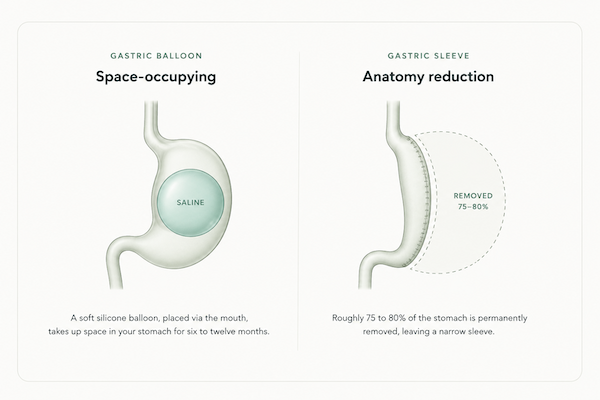
The gastric balloon is a non-surgical, endoscopic procedure. Your doctor places a soft silicone balloon in your stomach through your mouth using a thin, flexible camera called an endoscope, then fills it with saline. There are no incisions, no scars, and no removal of stomach tissue.
The whole process takes about 20 to 30 minutes and is done on an outpatient basis. The balloon is temporary. Depending on the device, it’s removed after six months. While it’s in place, it occupies space in your stomach so you feel full sooner and eat less. Everself runs one of the most established balloon programs in the country, pairing the device itself with structured aftercare (more on that below).
The pros and cons of the gastric balloon are worth weighing before you commit, especially around the first-week adjustment period.
What is gastric sleeve surgery?
Gastric sleeve surgery, also called sleeve gastrectomy, is a laparoscopic operation. Your surgeon permanently removes roughly 75 to 80% of your stomach, leaving a narrow, banana-shaped pouch behind. It requires general anesthesia, an operating room, and typically a one to two-night hospital stay.
The sleeve works on two levels. It physically restricts how much food your stomach can hold, and it alters hunger hormones like ghrelin, GLP-1, and PYY, which influence appetite and satiety. The change is permanent and irreversible.
The two procedures work through fundamentally different mechanisms, one temporary and space-occupying, the other permanent and structural.
Gastric Balloon vs. Gastric Sleeve: Side-by-Side Comparison
Here’s how the gastric balloon vs sleeve comparison breaks down on the factors patients ask about most. We’ve included ESG Stomach Tightening® for context, since it’s often the most relevant third option.
The balloon sits within a broader category of least invasive weight loss procedures, each with different tradeoffs in duration, cost, and outcomes.
Weight Loss Results: What to Realistically Expect
Numbers matter here, but context matters more. Both procedures produce real weight loss. They just produce different amounts of it, over different timelines, with different tradeoffs.
Gastric balloon weight loss timeline
If you choose the gastric balloon, you can expect to lose around 10 to 15% of your total body weight over six months. For someone starting at 220 pounds, that’s roughly 22 to 33 pounds. The pace is fastest in the first three months, when your stomach is adjusting, and portion sizes are smallest.
The honest caveat: weight regain is a real risk after the balloon comes out, especially without strong nutrition and lifestyle support during and after the six-month window. That’s why aftercare matters as much as the procedure itself. The 6-month gastric balloon results show how the pace of loss tends to taper after the early weeks.
At Everself, the Gastric Balloon program pairs the procedure with virtual visits from registered dietitians and nurse practitioners across the full six-month period, with proactive check-ins and a smart scale to keep your care team in the loop. The point is to use the balloon as a structured tool, not a quick fix.
Gastric sleeve weight loss timeline
If you choose the sleeve, you can expect to lose around 25 to 30% of your total body weight over 12 to 18 months, with the steepest drop in the first six months. Long-term studies show this loss is generally durable, with patients maintaining around 22 to 24% TWL at five years and beyond.
Results are larger and more durable than the balloon, but they come with a permanent anatomical change and the recovery and risks of an operation. A gastric sleeve weight loss chart shows how that curve typically unfolds, with the steepest drop in the first six months.
Sleeve patients aren’t immune to regain either. If habits drift or follow-up care thins out, weight regain after gastric sleeve is a documented pattern, and the anatomy can’t be adjusted without another procedure.
A third option: ESG weight loss results
Here’s where many patients get a useful surprise. ESG Stomach Tightening® produces an average of 20% total body weight loss, more than the balloon and approaching what many patients see with the sleeve, without surgery, incisions, or removal of stomach tissue.
ESG works by using endoscopic sutures placed through your mouth to reshape your stomach into a smaller, sleeve-like pouch. A study found ESG patients lost significantly more total body weight at both 6 months (19.8% vs 15.3%) and 12 months (22.5% vs 14.7%).
Average total body weight loss varies meaningfully across the three options.
See whether ESG Stomach Tightening® is right for you and get a free personalized recommendation.
Recovery Time and What to Expect Post-Procedure
Recovery is often the deciding factor if you’re balancing work, family, or caregiving. Here’s how the two compare.
Gastric balloon recovery
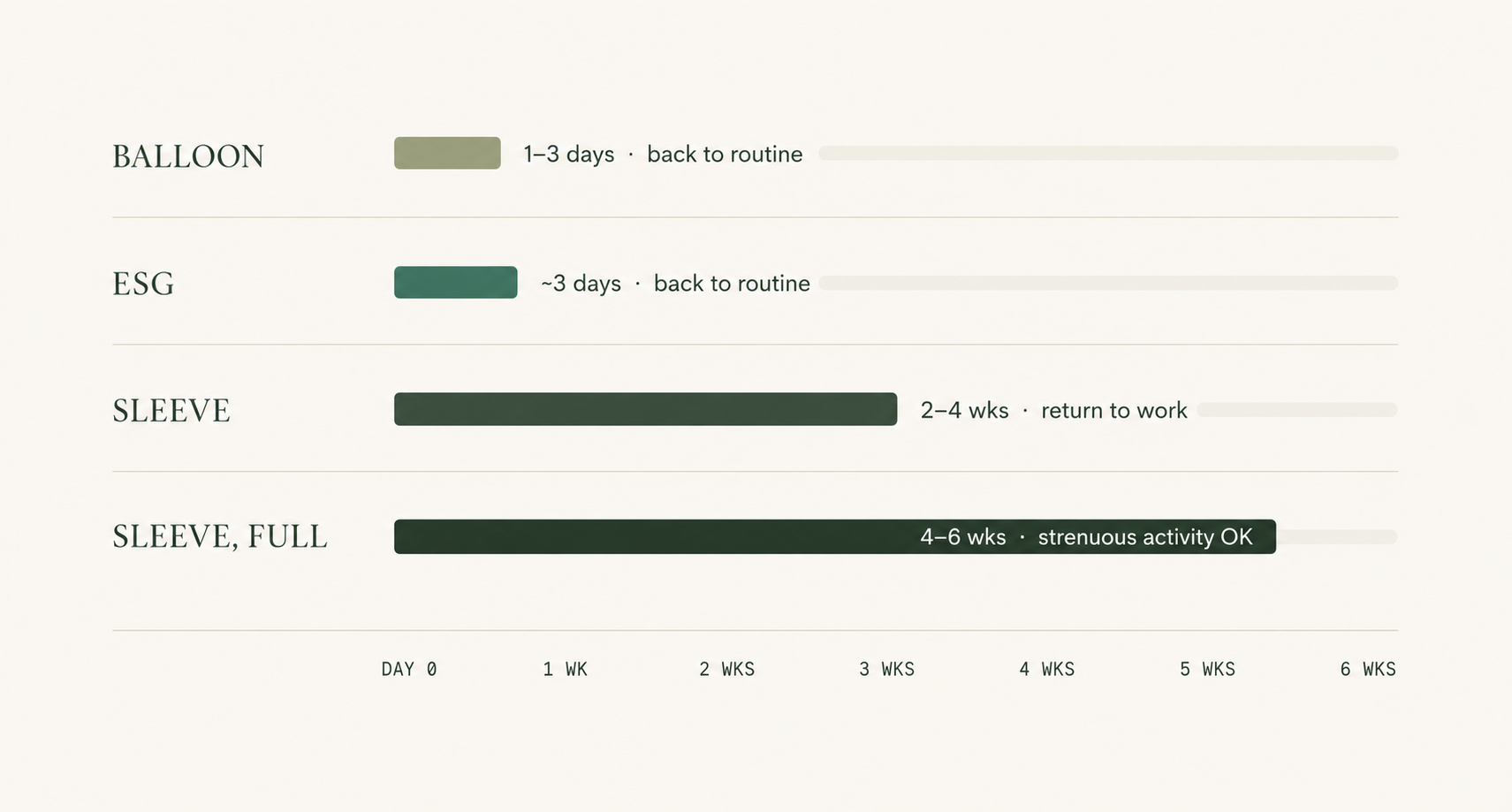
The balloon is an outpatient procedure. You’ll go home the same day and can usually resume normal activities within one to three days. The first week is the hardest part. Nausea, cramping, and vomiting are common as your stomach adjusts to the balloon. Around 55% of patients experience nausea in the first week, and 4 to 7% request early removal because they can’t tolerate the symptoms. For most patients, symptoms settle within a few days, and no surgical recovery follows. It’s a short adjustment period with no surgical recovery to follow.
Gastric sleeve recovery
Sleeve recovery is meaningfully longer. You’ll typically stay in the hospital for one to two nights. Most patients return to work in two to four weeks, sometimes longer for physical jobs. Strenuous activity is generally off-limits for four to six weeks. Your post-op diet progresses slowly through liquids, purees, and soft foods over several weeks. If you have a young family, a demanding job, or limited support at home, that recovery window matters.
Average total body weight loss varies meaningfully across the three options.
Risks and Safety Profile
Every weight loss procedure has risks. The question is what kind, and how serious.
Gastric balloon risks
The balloon’s safety profile is generally favorable. Serious complications are rare. The most common issues are short-term: nausea, cramping, abdominal pain, and reflux during the first week or two. Less common risks include balloon deflation, gastric perforation, and small bowel obstruction. Pooled data on the Orbera balloon report a mortality rate of approximately 0.08%, very low for a weight care procedure.
Because the balloon is reversible and doesn’t alter your anatomy, the long-term risk profile is more limited than that of a permanent surgery.
Gastric sleeve risks
The sleeve carries the risks that come with any major operation: blood clots, infections, staple line leaks, and bleeding. Staple line leak rates run approximately 1 to 3%, and reported mortality ranges from 0.05% to 0.22% in large registry studies. New or worsened acid reflux (GERD) is also common after the sleeve, with long-term data showing it develops in roughly a third of patients. Nutritional deficiencies in B12, iron, calcium, and vitamin D are common too, and they require lifelong supplementation and monitoring.
The most important thing to understand is permanence. If your outcomes don’t meet expectations or if complications arise, the anatomy can’t be undone. Revision options exist, but they’re another procedure on top of the first one.
The sleeve is the right answer for many patients, particularly those with higher BMIs and conditions like type 2 diabetes or sleep apnea. These risks are part of an honest conversation, not a reason to rule it out.
Who Is the Right Candidate for Each?
Both procedures work, but they work for different people. Honest candidacy is the difference between a successful outcome and regret.
Gastric balloon: pros, cons, and best-fit patients
Pros:
- Non-surgical and reversible, with no incisions or anatomical change
- Outpatient procedure with one to three days of recovery
- Lower upfront cost than sleeve or ESG
- Light sedation only, no general anesthesia
- Strong fit for a structured jumpstart or milestone-driven goal
Cons:
- Temporary, removed after six months
- Lowest average weight loss of the three options (10 to 15% TWL)
- Regain is a real risk without strong aftercare
- Around 55% of patients experience nausea in the first week, and 4 to 7% request early removal
Best fit: BMI 30 to 40, not eligible or not ready for surgery, motivated to use the six-month window to build lasting habits.
Gastric sleeve: pros, cons, and best-fit patients
Pros:
- Highest average weight loss (25 to 30% TWL) with durable long-term outcomes
- Hormonal changes that reduce hunger, not just physical restriction
- One-time surgical procedure
- Strong evidence for resolving conditions like type 2 diabetes and sleep apnea
Cons:
- Permanent and irreversible anatomical change
- Two to four weeks of recovery, general anesthesia required
- 1 to 3% staple line leak rate and 0.1 to 0.3% mortality range
- GERD develops in roughly a third of patients long-term
- Lifelong nutritional supplementation required
Best fit: BMI 35 to 40+, often with obesity-related conditions like type 2 diabetes, sleep apnea, or hypertension. Medically cleared for surgery, prepared for a permanent anatomy change and lifelong follow-up.
Could ESG be a better fit for you?
ESG is often the right answer if you fall in the BMI 30 to 40 range and want more weight loss than the balloon offers without committing to surgery. It produces meaningfully greater %TWL than the balloon, preserves your natural anatomy, and is performed without incisions.
It also fits the life you’re actually living. Most ESG patients are back to work and routine activities within a few days. The procedure is paired with The Everself Program, 12 months of concierge weight care including physicians, nurse practitioners, registered dietitians, and coaches who help you build habits that protect your results.
For many patients, the real question isn’t balloon vs sleeve but how to lose weight without bariatric surgery at all, especially when the goal is meaningful loss without permanent anatomical change.
Not sure which procedure fits your goals? Book a free consultation with the Everself team.
Cost Comparison: Gastric Balloon vs Gastric Sleeve
Cost is rarely the only factor, but it’s almost always part of the decision.
Here’s how to think about it.
The gastric balloon has the lowest upfront cost of the three options, but it’s a temporary tool. If you don’t use the six-month window to build durable habits, the long-term math gets harder. What’s included in gastric balloon cost varies by provider, but the upfront number is only part of the picture if aftercare isn’t built in.
Gastric sleeve has a higher upfront cost, plus the costs that come with surgery: hospital stay, anesthesia, follow-up procedures if complications arise, and lifelong nutritional supplementation. It’s a single procedure, but the surrounding costs add up over time.
ESG Stomach Tightening® falls between the two. It’s a one-time, non-surgical investment with no operating room costs, no hospital stay, and no permanent anatomical change. If you want durable results without the surgical price tag and risk profile, it’s often the most balanced choice.
Choosing Between the Gastric Balloon and Gastric Sleeve
The decision usually comes down to what you’re willing to commit to. The gastric balloon is reversible and non-surgical, but temporary. The gastric sleeve is more durable, but permanent and surgically invasive. Both are real options for the right patient.
If you have a BMI between 30 and 40 and you want meaningful, lasting weight loss without going under the knife, ESG Stomach Tightening® offers a third path: a one-time, non-surgical endoscopic procedure with strong outcomes and 12 months of concierge support to help you protect your results. You can see what that looks like in real patient results.
The right choice depends on your goals, your starting point, and your life. The Everself team can help you figure out which procedure fits, not just clinically, but realistically.
Every journey is different. Compare your options with confidence and book a consultation with the Everself team today.
Frequently Asked Questions
Is the gastric balloon as effective as the gastric sleeve?
No. The balloon averages 10 to 15% TWL over six months; the sleeve averages 25 to 30% TWL over 12 to 18 months. ESG Stomach Tightening® sits between the two at around 20% TWL, without surgery or permanent anatomical change.
Can you get a gastric sleeve after a gastric balloon?
Yes. A prior balloon doesn’t preclude future procedures, including the sleeve or ESG. Many patients use the balloon as a stepping stone before deciding on a longer-term option.
Which is safer, the gastric balloon or gastric sleeve?
The balloon has a lower complication profile. It’s non-surgical, reversible, and carries a mortality rate of around 0.08% in pooled studies. The sleeve carries a 1 to 3% staple line leak rate and a mortality range of 0.1 to 0.3% in large registry studies, plus long-term risks like GERD and nutritional deficiencies. “Safer” depends on your medical history, BMI, and goals, which is why a personalized consultation matters.
Is there a non-surgical option that works better than the gastric balloon?
Yes, ESG Stomach Tightening® is a one-time, non-surgical endoscopic procedure averaging 20% TWL, meaningfully more than the balloon and without the recovery or anatomy change of the sleeve. For BMI 30 to 40 patients who want durable results without surgery, it’s often the stronger fit.