Bariatric Pre Op Diet: The Liquid Diet Before Surgery, Explained
Preparing for bariatric surgery? Learn why the pre op liquid diet matters, how long it lasts, and how ESG Stomach Tightening skips the wait.

Global leader in endoscopic weight loss, Triple-board-certified in obesity
Your surgery date is finally on the calendar. Then your program tells you that weeks of shakes and broth come first. After months of waiting and paperwork, that news can feel like one more obstacle standing between you and the day you’ve been working toward.
It helps to know that this step isn’t arbitrary. The pre op liquid diet has a specific medical job, and it has very little to do with the number on your scale.
This guide explains what the diet actually does inside your body, how long it usually lasts, and what happens if you struggle with it. It also covers why one non-surgical option follows a completely different timeline.
Here’s What You’re Signing Up For
- The bariatric pre op diet isn’t mainly about losing weight, according to Dr. Christopher McGowan, Everself’s SVP of Peri-procedural Care. Its real job is making surgery easier and potentially safer.
- Most programs prescribe 2 to 6 weeks of liquids. Starting BMI, liver size, surgeon preference, and program protocol all drive where you land in that range.
- A high-protein, low-carbohydrate liquid diet depletes liver glycogen and fat stores, which reduces liver size and improves the surgeon’s view during laparoscopic surgery.
- Research on patients with fatty liver disease found that a two-week low-calorie diet before bariatric surgery improved liver histology.
- Surgeons may postpone a procedure if the liver hasn’t shrunk enough by the scheduled date. This decision protects patient safety rather than punishing anyone.
- Hunger, fatigue, and mild headaches often show up in the first few days of the diet and usually ease as the body adjusts.
- ESG Stomach Tightening® reaches the stomach through the mouth, so liver size never blocks access. Standard prep is one day of clear liquids instead of several weeks.
- Every program writes its own rules, so your bariatric team’s instructions always override anything you read online.
What Is the Bariatric Pre Op Diet
The bariatric pre op diet is a short-term, high-protein, low-carbohydrate liquid diet. Programs prescribe it in the weeks before a laparoscopic weight loss procedure. Gastric sleeve and gastric bypass are the two most common ones, and the gastric sleeve vs gastric bypass comparison explains how they differ in approach and recovery.
The same core principle applies across nearly all traditional bariatric procedures. Your surgeon’s program sets the exact protocol, which is why two patients at different clinics can get different instructions.
Almost every patient preparing for traditional bariatric surgery completes some version of this diet. Getting assigned one says nothing negative about your case or your progress so far.

Nearly every traditional bariatric program includes some version of a pre op liquid diet.
Why You Need a Liquid Diet Before Bariatric Surgery
Most programs hand you the diet without explaining the reasoning behind it. That gap is why the requirement often feels like a hurdle instead of care.
The logic is straightforward once someone walks you through it: your surgeon needs a clear, unobstructed view of your stomach, and the diet is what gets your body there.
It’s about surgical safety, not weight loss
Dr. Christopher McGowan, Everself’s SVP of Peri-procedural Care, reframes what this diet is actually doing: making the surgery itself easier, and potentially safer, to perform, not shrinking the reader beforehand.
It’s a useful reframe. You’re not auditioning for your surgery, you’re already doing part of the medical preparation.
Why a fatty, enlarged liver complicates surgery
Excess weight often comes with some degree of fatty liver disease, which enlarges the liver. Dr. McGowan explains that this creates a technical problem in the operating room.
The liver sits directly over the stomach. During laparoscopic surgery, the surgeon has to lift it out of the way to reach the surgical field. A larger, fattier liver is heavier and harder to move.
How the liquid diet shrinks the liver
High-protein, low-carbohydrate liquids force the body to burn through stored liver glycogen and fat. The liver gets measurably smaller as those stores deplete. Better visualization and easier access follow from that change.
The evidence supports the practice. In one 2019 Johns Hopkins study of patients with fatty liver disease, a two-week low-calorie diet before bariatric surgery measurably improved liver tissue, meaning less fat buildup and inflammation under the microscope. The other benefits worth knowing
Two smaller benefits come along with the main one. Most patients lose a modest amount of weight during the diet, which can further ease the procedure.
The diet also gives you a head start on post-op eating. You’ll drink liquids and eat very small volumes right after surgery, so the adjustment begins before you’re recovering from anesthesia.
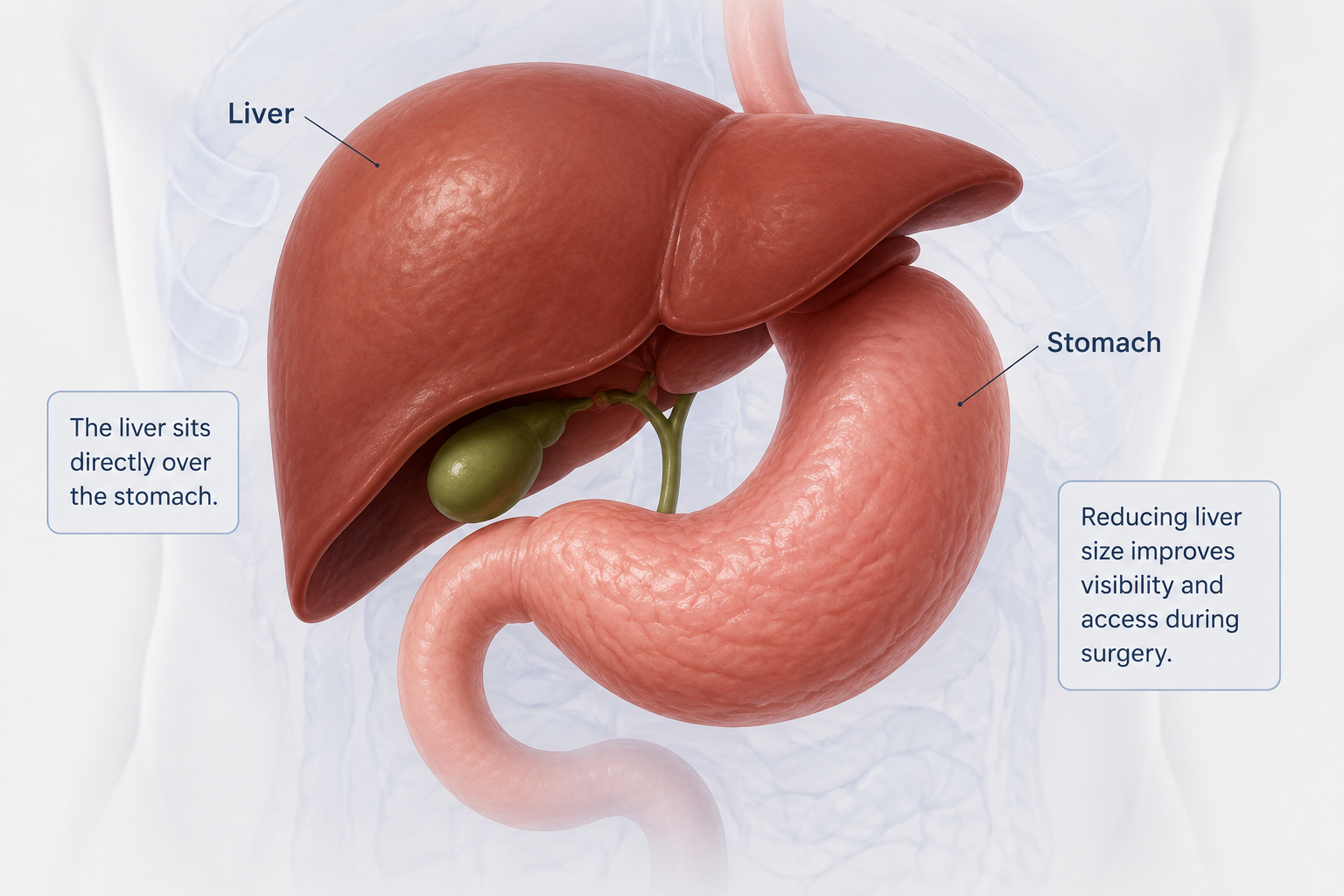
Depleting liver glycogen and fat gives surgeons a clearer view of the stomach.
How Long the Pre Op Liquid Diet Typically Lasts
Dr. McGowan puts the realistic range at roughly 2 to 6 weeks. He’s clear that no single fixed number fits every patient, because the factors behind the timeline vary so much.
Your starting BMI, liver size, your surgeon’s preference, and your program’s own protocol together determine where you land in that range.
Treat your own team’s instruction as the only timeline that counts. They’ve reviewed your imaging, your labs, and your history in a way no article can.

Timelines vary because BMI, liver size, and surgeon preference all influence the plan.
Not sure a multi-week runway fits your life right now? The ESG weight loss pros and cons breakdown lays out how a non-surgical path differs before you commit.
What to Expect Day to Day
Most plans follow a similar arc: full liquids first, like protein shakes, strained soups, and broths, then clear liquids only in the final day or two.
The first few days are usually the hardest. Hunger, fatigue, and mild headaches are common as your body shifts away from carbohydrates. These symptoms typically settle within about a week.
Some medications need adjusting or pausing during this window; insulin doses are a common example for patients managing diabetes. Your bariatric team will give you the full list, since it depends on your prescriptions and your health history.
Portions and allowed extras differ from program to program, right down to specific drink brands. When online advice conflicts with your dietitian’s plan, follow your dietitian.
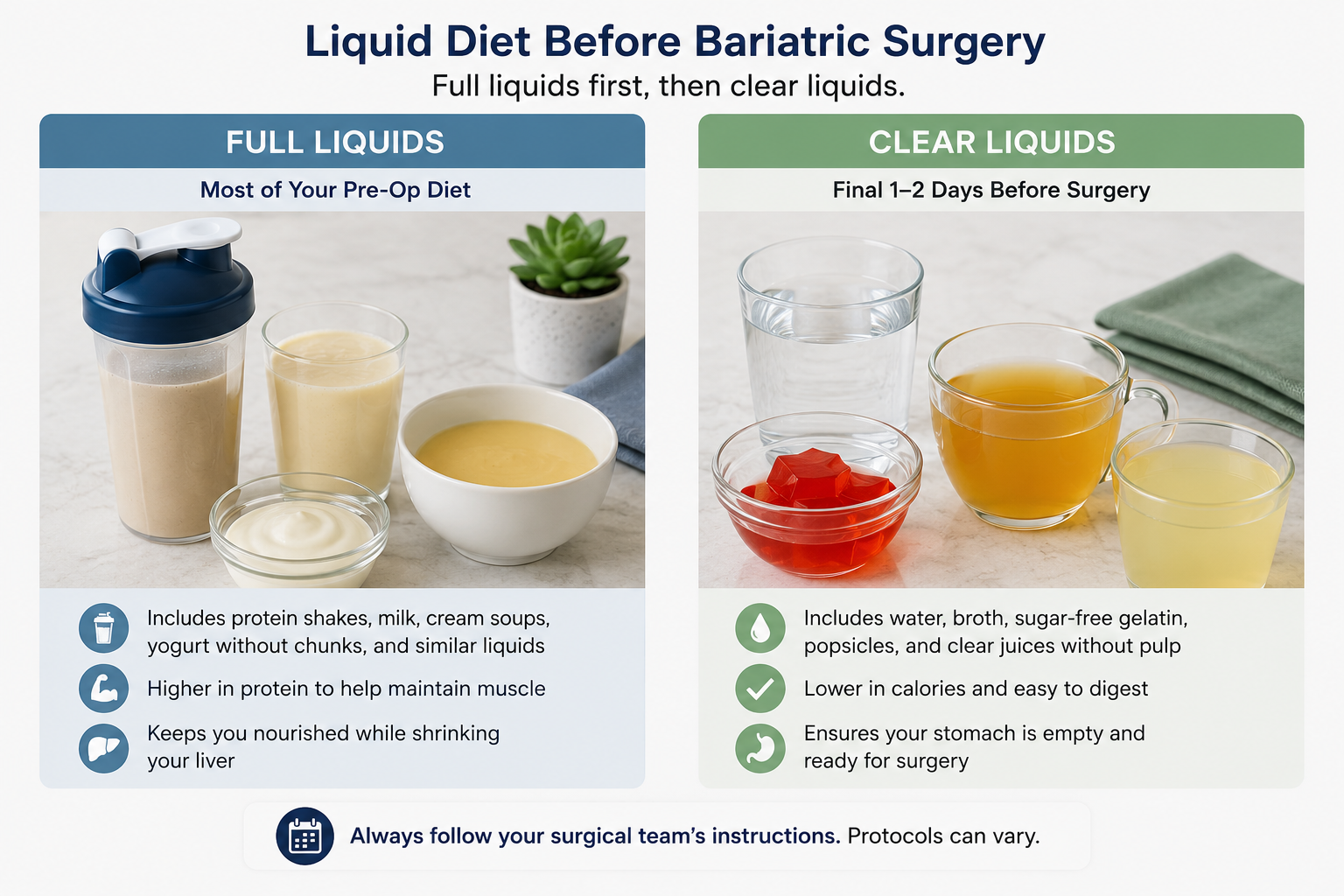
Full liquids come first, with clear liquids in the final day or two before surgery.
What Happens If You Don’t Follow the Pre Op Diet
If the liver hasn’t shrunk enough by surgery day, the surgeon may delay or postpone the procedure.
It’s a genuinely frustrating outcome after weeks of effort and scheduling. It isn’t a judgment on you, though. A surgeon who postpones is protecting you from a riskier operation.
Reach out early if the diet isn’t working. Patients who can’t tolerate the liquids, or who manage diabetes or kidney disease, often need a modified plan that only their own team can build safely.
Skipping the Weeks of Liquids: How ESG Stomach Tightening Compares
The short answer is no. The prep looks completely different, and the reason comes down to how the procedure reaches the stomach.
That distinction surprises a lot of patients who assume every weight loss procedure starts with weeks of shakes. Here’s why the timeline changes.
Why ESG changes the equation
ESG Stomach Tightening® works through the mouth rather than through the abdomen. It’s a one-time, non-surgical endoscopic procedure that reshapes the stomach from the inside using sutures.
Dr. McGowan notes what that means practically. Nobody lifts or works around the liver during an endoscopic procedure, so liver size stops being a technical obstacle at all.
What pre-procedure prep looks like for ESG instead
The standard prep is a single day of clear liquids. Its purpose is simply making sure the stomach is empty when the procedure begins.
For anyone dreading a multi-week runway, this difference can change the whole plan. Patients often ask what to expect before and after ESG, and the prep window is usually the first surprise.
| Traditional Bariatric Surgery | ESG Stomach Tightening® | |
|---|---|---|
| Purpose of prep | Shrinking the liver for safer surgical access | Emptying the stomach before the procedure |
| Typical duration | 2 to 6 weeks | 1 day |
| Diet type | High-protein, low-carbohydrate liquids | Clear liquids |
| Reason for the difference | The surgeon must lift the liver during laparoscopic surgery | The procedure is endoscopic, so liver size isn’t a factor |
Readers weighing both paths often start with esg vs vsg, which compares restriction, recovery, and long-term results side by side.
Making Your Decision With Confidence
The pre op liquid diet protects you during surgery. It isn’t a willpower test, and struggling with it doesn’t mean you’re failing.
If you’re already scheduled, follow your team’s plan and call them when something feels off. That’s what they’re there for.
If you haven’t committed yet, this is a fair moment to compare timelines honestly. Some patients also look at the gastric balloon pros and cons alongside ESG Stomach Tightening® before choosing.
Everself pairs one-time, non-surgical care with 12 months of concierge support from physicians, dietitians, and coaches. You can book your consultation to talk through which path fits your goals and your calendar.
Quick Questions About the Pre Op Diet
Can I still have coffee or caffeine?
Most programs limit caffeine on the liquid diet, and some allow decaf. The exact rule comes from your own bariatric team.
Will I lose weight just from the diet itself?
Many patients do see some weight loss during this phase, though how much varies by program and starting point. Your dietitian can tell you what’s typical for your plan.
Is it just hunger, or should I expect other symptoms too?
Along with hunger and headaches, some patients notice mild nausea or irritability in the first few days. These are common and usually pass. Call your team if anything feels severe.
Sources
- A Two-Week Low-Calorie Diet Improves Liver Histology in Patients With Non-Alcoholic Fatty Liver Disease Before Bariatric Surgery. (2019). PubMed.
Found on: https://pubmed.ncbi.nlm.nih.gov/31558407/ - FAQs of Bariatric Surgery. (2026). American Society for Metabolic and Bariatric Surgery.
Found on: https://asmbs.org/patients/faqs-of-bariatric-surgery/