Suture Sculpt ESG vs Gastric Sleeve: What to Know
Wondering what "Suture Sculpt" means for ESG vs gastric sleeve? Get a clear breakdown of the technique, outcomes, and how to choose with confidence.

Global leader in endoscopic weight loss, Triple-board-certified in obesity
Patients come to us worn out by research long before they come to us about weight. They’ve done the diets, maybe the medications, and they’re now comparing procedures across a dozen open tabs. Then a name like “Suture Sculpt” appears, and the picture gets murkier than it was an hour ago.
Publicly, the procedure behind the name “Suture Sculpt” appears to work the same way endoscopic sleeve gastroplasty (ESG) does: an endoscope and internal sutures.
That’s usually enough to clear up most of the confusion, at least about what you’re actually deciding between: a non-surgical endoscopic approach or gastric sleeve surgery.
What You Need to Know
- The procedure behind the name “Suture Sculpt” appears to follow the same basic approach as endoscopic sleeve gastroplasty (ESG): an endoscope and internal sutures.
- ESG is incisionless and performed through the mouth, and no part of the stomach is removed.
- Gastric sleeve surgery staples and permanently removes roughly 75 to 80 percent of the stomach.
- ESG generally produces around 15 to 20% TWL, while gastric sleeve surgery commonly reaches 25 to 30% TWL.
- Reflux is one of the sharpest differences, since gastric sleeve surgery can create or worsen GERD while ESG leaves the gastroesophageal junction intact.
- Most ESG patients return to desk work within two to three days, while gastric sleeve patients often need one to two weeks.
What “Suture Sculpt” Actually Refers To
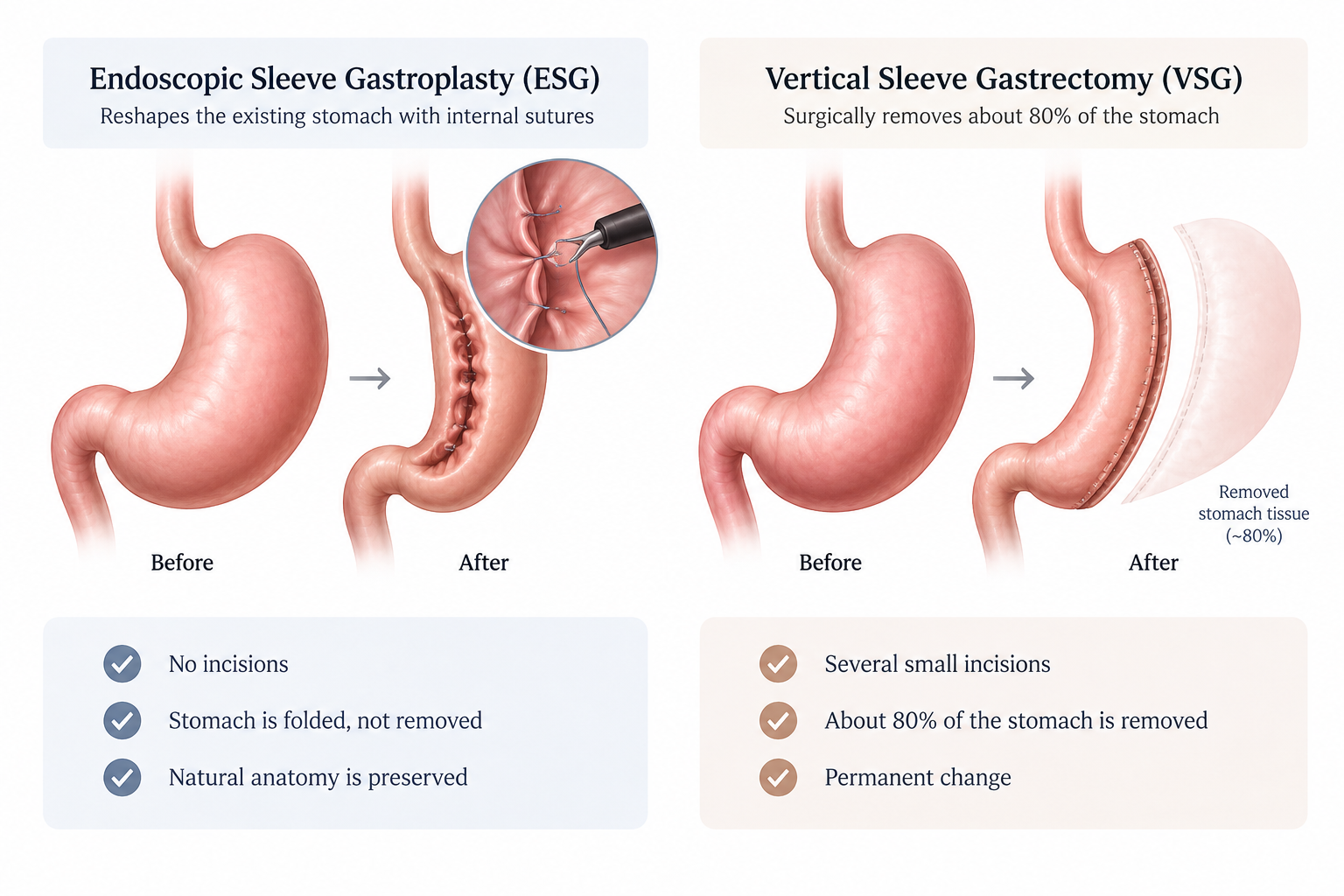
See exactly how each sleeve option reshapes your stomach, no matter what a provider calls it. Source: Everself
The procedure behind that name, as it’s publicly described, works the same way ESG does: an endoscope placed through the mouth, sutures placed from the inside to fold and reshape the stomach, nothing cut or removed. Some providers also package the procedure together with medication and coaching under one program name.
This mechanism- endoscope in, sutures placed, stomach reshaped from the inside- is generally what defines ESG, regardless of what a given program calls it.
Nothing gets cut, and nothing leaves your body. You won’t have abdominal incisions, staples, or scars. Your stomach and its junction with the esophagus stay anatomically intact.
Why this matters before you compare procedures
Once you see that this comes down to the same basic approach as ESG, the comparison gets much easier. You’re not weighing three separate procedures. You’re weighing a non-surgical endoscopic approach against gastric sleeve surgery.
That’s the question worth your research time. Names for this procedure will keep varying depending on where you look. The underlying choice stays the same.
How Suture Sculpt ESG Compares to Vertical Sleeve Gastrectomy (VSG)

Gastric sleeve surgery happens in an operating room, while ESG happens through the mouth. Source: Everself
Both procedures work mainly by restriction. They reduce how much food you can comfortably eat and help you feel full sooner. Neither one bypasses the intestine or deliberately causes malabsorption.
The difference lies in how each one gets there. ESG folds and sutures the stomach through an endoscope. VSG is surgery, performed laparoscopically through abdominal incisions, and it removes 75 to 80 percent of the stomach.
This difference is permanent on one side only. Patients often want to know: Is gastric sleeve reversible? Once removed, that tissue can’t be restored. A full ESG vs VSG comparison covers every factor in depth, so this section sticks to the two that matter most: recovery and what actually drives fullness and hunger.
Recovery and downtime
ESG patients typically go home the same day, and most return to desk-type work within two to three days. Nausea, cramping, and fatigue can still show up during that first week.
Gastric sleeve recovery runs longer. Many patients need one to two weeks before returning to work, with restrictions on heavy lifting and strenuous activity often continuing for several weeks after that.
For parents and people who can’t step away from work, that gap frequently settles the decision.
Weight loss outcomes
Surgery wins on weight loss, and the gap is real: published outcomes run roughly 15 to 20% TWL after ESG and 25 to 30% TWL after gastric sleeve surgery. A 2026 meta-analysis of 7,468 patients found ESG averaged 12.5 percentage points less total weight loss at one year, though your own result depends on starting weight, technique, follow-up program, and any obesity medications you use. Both options substantially outperform lifestyle change alone, and neither works without nutrition, movement, and long-term follow-up.
Reflux, hunger, and how fullness happens
This is the comparison most articles skip, and it changes decisions more than the weight figures do.
Gastric sleeve surgery can create new reflux or worsen existing GERD. Studies have reported clinically significant reflux in a substantial share of patients afterward, sometimes approaching a third. The exact figure depends on how reflux gets defined and how long patients are followed.
ESG has a much lower tendency to cause new reflux. It doesn’t create the narrow, high-pressure gastric tube that surgery produces, and the gastroesophageal junction stays intact. If you already have significant GERD, ask your provider about gastric sleeve vs gastric bypass, since bypass sometimes suits reflux patients better.
Hunger control runs the other way. Removing the gastric fundus cuts production of ghrelin, a major hunger hormone, so VSG suppresses appetite more directly. ESG slows gastric emptying instead, which keeps smaller meals in the stomach longer and extends satiety.
Safety and risk profile
Both procedures have low complication rates at experienced centers. A 2026 study of more than 1.1 million patients found no significant difference in major adverse events between ESG and gastric sleeve surgery overall, so the bigger distinction is the type of risk you’re weighing: ESG carries no incision-related complications, while gastric sleeve surgery carries the risks that come with abdominal surgery and stomach removal, including bleeding, infection, staple-line leak, blood clots, and stricture. Bring your full medical history to whoever you consult, and ask what complications they’ve seen and how they handle them.
Want to see how these numbers apply to your situation? Review your options with an Everself specialist before you narrow anything down.
What Actually Varies Between ESG Techniques
ESG results aren’t uniform across providers, and technique explains much of the spread. Two variables matter most. The first is how many sutures a doctor places, and the second is how deep each suture goes.
Full-thickness suturing anchors the stitch through every layer of the stomach wall. Endoscopic suturing systems built for ESG are designed to deliver these full-thickness stitches. Shallower stitches are more likely to loosen, which weakens how well the reshaping holds.
Suture count follows the same logic. Fewer sutures shorten the procedure and lower the cost to the clinic. They also leave less structure behind to maintain the new stomach shape.
Everself built its ESG Stomach Tightening® protocol around a higher suture count and a full-thickness technique. The Everself Program then pairs the procedure with twelve months of concierge support. Registered dietitians and nurse practitioners stay involved long after your procedure day.
Use those questions with any provider you’re considering. Ask how many sutures they place, whether those sutures go full thickness, and what the year after looks like. Our breakdown of ESG weight loss pros and cons covers what else belongs on that list.
Who Tends to Be a Good Fit for Each Option

A consultation is the fastest way to find out which column describes your situation. Source: Everself
General candidacy for ESG and gastric sleeve
ESG Stomach Tightening® generally suits adults with a BMI over 30. It may also fit people with a BMI of 27 to 29.9 who have an obesity-related condition. Type 2 diabetes, sleep apnea, and high blood pressure all count here.
Gastric sleeve surgery usually requires a BMI of 40, or 35 with a related condition. That higher threshold leaves out many people who still want meaningful medical help.
Goals matter as much as numbers. Patients who need the largest possible weight loss often lean surgical. Patients who prioritize lower risk, faster recovery, and a preserved stomach often lean endoscopic.
When to loop in a specialist
Some histories need a closer look before you choose anything. Prior bariatric surgery, significant GI conditions, and complex medical histories all affect candidacy. Existing reflux deserves particular attention before you consider surgery.
Bring your records to a qualified provider and ask directly about candidacy. A good specialist will tell you when one path clearly fits better. They’ll also tell you when neither one does.
Choosing with Clarity Instead of Confusion
Neither procedure is universally better. The tradeoff is straightforward. Gastric sleeve surgery generally delivers greater average weight loss and stronger hunger suppression.
ESG generally delivers lower procedural risk, faster recovery, a preserved stomach, and less concern about reflux. It also keeps future treatment options open, because no tissue is removed. Which set of advantages matters more depends on your health picture, not on a ranking.
None of this says anything about your discipline. Obesity is a medical condition, and the plans that didn’t hold weren’t a willpower problem. You’re selecting a treatment, not proving something about yourself.
What shouldn’t drive the decision is the name attached to a program. Different providers describe their approach differently, whether that’s Suture Sculpt, stomach tightening, or endoscopic sleeve gastroplasty. Technique and follow-up care are what separate one program from another.
See whether ESG Stomach Tightening® is right for you. Book a consultation with Everself and leave with clear criteria, whichever path you choose.
Common Questions About Suture Sculpt and ESG
Is Suture Sculpt the same as ESG Stomach Tightening®?
Based on how each is publicly described, both fall under the broader umbrella of endoscopic sleeve gastroplasty. Beyond that, the protocol is what varies: Everself’s version specifies a higher suture count, full-thickness suturing, and twelve months of follow-up care.
Does insurance cover Suture Sculpt or ESG?
Coverage has changed quickly, and older articles will tell you otherwise. ESG was primarily self-pay for years, but Medicare now covers it. Commercial coverage has expanded since permanent CPT code 43889 arrived in 2026.
Gastric sleeve surgery has been an established insurance benefit for much longer. If you’re budgeting, weigh your out-of-pocket ESG quote against gastric sleeve surgery cost, including follow-up care and supplements.
Can you switch between a non-surgical and surgical option later?
Often, yes, and that flexibility is one reason people start with ESG. Because sutures reshape the stomach without removing tissue, surgical options generally remain available. Your provider will still review your anatomy and history before recommending a next step.
Sources
ENDOSCOPIC SLEEVE GASTROPLASTY VERSUS LAPAROSCOPIC SLEEVE GASTRECTOMY: A SYSTEMATIC REVIEW AND META-ANALYSIS. (2026). Obesity Surgery. FOUND ON: https://pubmed.ncbi.nlm.nih.gov/41917549/
COMPARATIVE SAFETY OF ENDOSCOPIC SLEEVE GASTROPLASTY VERSUS LAPAROSCOPIC SLEEVE GASTRECTOMY: A META-ANALYSIS OF OVER 1.1 MILLION PATIENTS. (2026). PubMed. FOUND ON: https://pubmed.ncbi.nlm.nih.gov/41998484/
OVERSTITCH ENDOSCOPIC SUTURING SYSTEM PHYSICIAN BROCHURE. (2023). Boston Scientific. FOUND ON: https://www.bostonscientific.com/content/dam/apollo-endo/mktg-kit/overstitch-physician-brochure.pdf