Comparing ESG vs VSG? Explore 12 Factors That Matter Most
Weighing ESG vs VSG? Compare recovery, cost, and expected weight loss side by side to find the sleeve option that fits your life.

Global leader in endoscopic weight loss, Triple-board-certified in obesity
Choosing between a surgical and a non-surgical sleeve is a big decision. You’re probably weighing permanence, recovery time, and whether a less invasive option can really hold up. It’s normal to want facts instead of marketing claims.
ESG Stomach Tightening® and vertical sleeve gastrectomy (VSG) both reshape the stomach so you eat less. They get there in very different ways. Dr. Christopher C. Thompson, Everself’s co-founder, helped pioneer the endoscopic approach at Harvard Medical School.
This comparison covers recovery, cost, reported weight loss, reflux risk, and what happens in the year after your procedure.
Key Takeaways
- ESG Stomach Tightening® is a one-time, non-surgical endoscopic procedure that folds the stomach with internal sutures, while VSG is surgery that permanently removes 75% to 80% of the stomach.
- Both procedures work by restriction, not malabsorption. Neither one bypasses the intestine.
- VSG generally produces more weight loss. Patients commonly lose 25% to 30% of total body weight after VSG, compared with 15% to 20% after ESG.
- Reflux is the sharpest clinical difference. VSG can cause or worsen GERD in a substantial share of patients, while ESG leaves the gastroesophageal junction intact.
- A 2025 analysis of 506,597 patients found no significant difference in serious 30-day complications between the two procedures, though ESG patients made fewer emergency department visits.
- Most ESG patients return to desk work in about two to three days. VSG recovery commonly takes one to two weeks, with activity restrictions lasting longer.
- ESG is available at a BMI of 30 or higher, or 27 to 29.9 with a related health condition. Gastric sleeve surgery usually requires a BMI of 40, or 35 with a related condition.
- Insurance coverage for ESG is expanding. A permanent CPT code (43889) took effect in January 2026, and more Medicare and commercial plans have moved toward coverage since, though it isn’t universal yet.
Understanding the Difference Between ESG and Gastric Sleeve
The core difference is simple. ESG Stomach Tightening® reshapes the stomach you already have. Gastric sleeve surgery removes most of it.
Both procedures are primarily restrictive. They reduce how much food you can comfortably eat and help you feel full sooner. Neither one reroutes your intestine or causes intentional malabsorption.
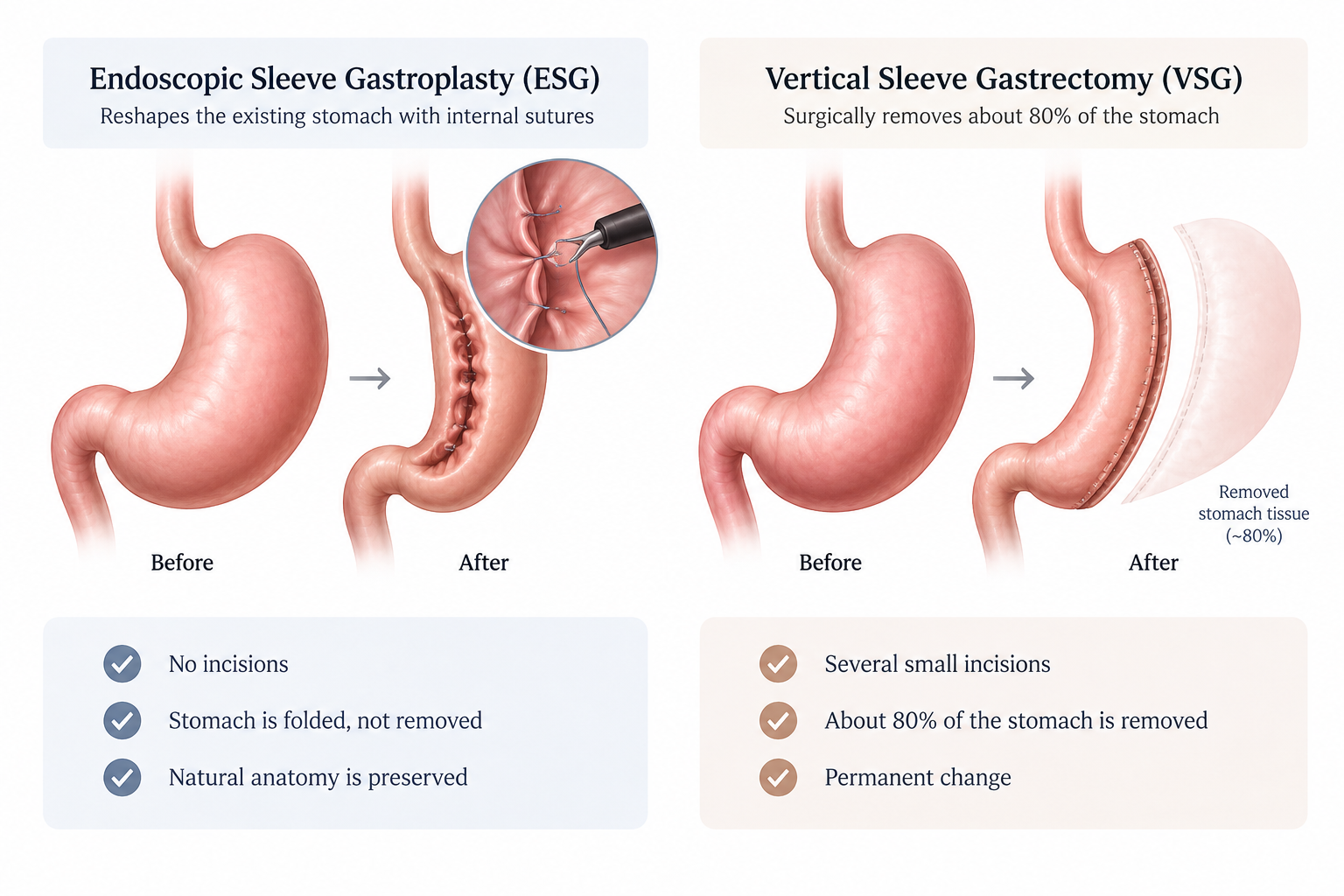
See exactly how each sleeve option changes your stomach before you choose one. Source: Everself
What is ESG Stomach Tightening®?
A physician passes a flexible endoscope through your mouth while you’re under anesthesia. Using a suturing device, they fold the stomach wall into a narrow tube. No part of the stomach comes out.
There are no incisions and no scars. Dr. Thompson developed and patented the endoscopic suturing techniques behind ESG Stomach Tightening® while at Harvard. He performed the first ESG procedures with current technology in 2012.
What is VSG (gastric sleeve surgery)?
A surgeon works laparoscopically through small abdominal incisions. Staples divide the stomach, and the surgeon permanently removes roughly 75% to 80% of it. What remains is a slim, tube-shaped pouch.
VSG is the most common bariatric surgery in the United States. It has decades of outcome data behind it, and it produces the largest average weight loss of any restrictive procedure.
Quick-Reference Comparison: ESG vs VSG at a Glance
Here’s the short version before we get into detail. ESG Stomach Tightening® and VSG differ most on invasiveness, recovery, reflux risk, and reversibility.
| Factor | ESG (non-surgical) | VSG (surgical) |
|---|---|---|
| Invasiveness | Endoscopic, no incisions | Laparoscopic, small incisions |
| Recovery | Desk work in about 2 to 3 days | Often 1 to 2 weeks |
| Procedure length | 45 to 90 minutes | About 70 minutes on average |
| Typical total weight loss | 15% to 20% | 25% to 30% |
| Reflux risk | Low, anatomy stays intact | New or worsened GERD is common |
| Cost | $12,995 at Everself | Roughly $15,000 to $25,000 self-pay |
| Reversibility | Sutures can be adjusted or removed | Permanent; tissue is removed |
| BMI eligibility | 30 and above, or 27 to 29.9 with a condition | 40 and above, or 35 with a condition |
If you’re not sure which column describes your situation, a consultation is the fastest way to find out. A medical provider reviews your BMI, health history, and goals, then tells you honestly whether ESG fits. Book a free consultation.
Comparing ESG and Gastric Sleeve Surgery, Factor by Factor
Not every factor below will matter equally to you. Read these as a way to rank your own priorities, not as a scorecard. Most people find that two or three factors decide it.

Compare the factors that actually shape your day-to-day experience after each procedure. Source: Everself
Invasiveness and procedure approach
ESG Stomach Tightening® is a one-time, non-surgical endoscopic procedure performed entirely through the mouth. Nothing is cut, stapled, or removed. You leave with no external wounds.
VSG requires general anesthesia, abdominal incisions, and a stapled resection. That’s standard, well-practiced surgery. It’s also the reason recovery takes longer.
Recovery time
Most ESG patients rest for one to two hours after the procedure and go home the same day. Most return to desk-type work within two to three days. Nausea, cramping, or fatigue can show up during the first several days, and all of that is expected.
During the first 72 hours, your care team monitors you closely and answers questions as they come up. Everself also provides complimentary IV hydration at select partner locations to make those days easier.
VSG recovery generally takes longer. Many patients need one to two weeks before returning to work. Restrictions on heavy lifting or strenuous activity can last several more weeks.
Hospital stay
ESG is an outpatient procedure. In the 2025 MBSAQIP analysis, ESG patients were discharged an average of 0.19 days after the procedure. Sleeve gastrectomy patients averaged 1.21 days.
The Weill Cornell comparison found a wider gap, at 0.34 days for ESG versus 3.09 days for surgical sleeve. Either way, one path involves a hospital admission, and the other usually doesn’t.
Procedure duration
At Everself, ESG takes 45 to 90 minutes depending on your anatomy. Add preparation and recovery, and you should plan for roughly half a day on site.
Surgical sleeve operative time averaged 69 minutes in the MBSAQIP data. The procedure itself isn’t long. The hospital stay is what extends the experience.
Weight loss outcomes
Surgical sleeve produces more weight loss on average, and it’s worth saying that plainly. Patients commonly lose 25% to 30% of total body weight after VSG. ESG typically produces 15% to 20%, with results varying by patient, technique, and follow-up program.
Published comparisons line up with those ranges. Researchers at Weill Cornell followed 278 patients and reported 29.3% total weight loss at 12 months after surgical sleeve, compared with 17.6% after ESG. A 2026 review in Frontiers in Endocrinology cites long-term mean total weight loss of 22.9% after sleeve gastrectomy.
Here’s what those percentages look like in pounds. Someone starting at 200 pounds would lose about 40 pounds at 20% total weight loss. The same person would lose about 60 pounds at 30%.
Adding GLP-1 medication narrows that gap for some patients. The Frontiers review reports 17% to 25% total weight loss when GLP-1 therapy accompanies ESG, compared with 15% to 21% for ESG alone. Your medical provider can tell you whether that combination suits your profile.
Both procedures outperform lifestyle changes alone for people with obesity. Nutrition, movement, and long-term follow-up still decide how much of that result you keep.
Hunger, fullness, and how each procedure works
The two procedures create fullness through different physiology, and this matters more than most comparisons admit. ESG slows gastric emptying. Smaller meals stay in the stomach longer, which extends how long you feel satisfied.
VSG speeds gastric emptying and drives greater hormonal change. Removing the gastric fundus cuts production of ghrelin, one of the body’s main hunger signals. That gives VSG a real advantage in appetite suppression.
ESG preserves the fundus, so it doesn’t reduce ghrelin the same way. Its effect on appetite comes from reduced capacity, altered mechanics, and delayed emptying instead.
Reflux and GERD
Reflux is one of the most important differences between these two procedures. VSG can trigger new reflux or worsen existing GERD. Studies have reported clinically significant reflux in a substantial share of patients, sometimes approaching one in three depending on the definition and follow-up period.
ESG rarely causes new reflux. The stomach and the junction where it meets the esophagus stay anatomically intact, and ESG doesn’t create the narrow, high-pressure tube that surgery does.
If you already have significant GERD, raise it early in your consultation. Some patients with reflux are better served by a different procedure, such as gastric bypass.
Potential risks and complications
Both procedures are safe in trained hands, and the data here is reassuring. The MBSAQIP analysis of 506,597 patients found serious 30-day complications in 2.3% of ESG cases and 2.0% of sleeve gastrectomy cases. That difference wasn’t statistically significant.
Short-term complication rates trend lower with ESG in published studies, often at 1% to 2% or less in experienced centers. Emergency department visits followed the same pattern, at 4.6% for ESG versus 7.2% for surgical sleeve.
VSG carries the risks that come with abdominal surgery and stomach removal. Those include bleeding, infection, leaking at the staple line, blood clots, and narrowing of the sleeve. Your surgical team should walk you through each one.
Reversibility
ESG leaves your stomach intact. The sutures hold the fold in place, which preserves more treatment options if your needs change later. That preserves more treatment options if you need additional help down the road.
VSG removes stomach tissue permanently. The original anatomy can’t be restored. That permanence reassures some people and stops others cold.
Cost
Everself prices ESG Stomach Tightening® at $12,995, and financing starts at $297 per month. That price includes 12 months of personalized weight care. The ESG pricing and financing page breaks down the full cost and what financing looks like.
Self-pay gastric sleeve surgery in the U.S. typically runs $15,000 to $38,000, putting the average closer to $19,459. Location, surgeon experience, and whether the procedure is inpatient or outpatient drive most of the variation.
Coverage used to favor surgery, because bariatric operations have been established insurance benefits for years. That’s changing: a permanent CPT code (43889) took effect in January 2026, and more plans have moved toward covering ESG since, though coverage still varies by payer. Check your specific plan against our breakdown of whether ESG is covered by insurance.
Eligibility
ESG suits adults with a BMI of 30 or higher. It may also fit people with a BMI of 27 to 29.9 who have a related health condition, such as type 2 diabetes, sleep apnea, or high blood pressure.
Gastric sleeve surgery typically requires a BMI of 40, or 35 with a related condition. That threshold rules out many people who still want meaningful help.
IA balloon might be worth a look if you want a lower-commitment starting point. We’ve laid out how it stacks up against ESG in ESG vs gastric balloon.
Not sure which bracket you fall into? See if you qualify and get a clear answer in one call.
Lifestyle and dietary changes
Both procedures require the same habits to work. You’ll start on liquids, move to soft foods, and then return to regular eating as your care team guides you. Protein comes first at every meal.
Neither option does the work for you. What each one does is make smaller portions feel satisfying instead of punishing. That’s the difference most patients notice first.
Exercise after ESG and VSG
After ESG, light walking starts almost immediately. Most people resume normal activity within a few days and return to full workouts within a couple of weeks.
After VSG, surgeons usually restrict lifting and strenuous exercise for four to six weeks while incisions heal. Ask your surgical team for a specific timeline, since guidance varies.
Follow-up care and long-term support
This is where providers differ more than procedures do. Both ESG and VSG depend on what happens in the months afterward, and many programs hand you a pamphlet and a follow-up appointment.
Everself includes 12 months of concierge care with every procedure. The Everself Program gives you a multidisciplinary team of physicians, nurse practitioners, registered nurses, dietitians, and coaches, backed by dedicated care support. A smart scale sends your progress to that team automatically, so they can adjust your plan in real time.
Comprehensive lab work comes with the program too, all through one app, at no additional cost.
Already Had Gastric Sleeve and Regained Weight?
Regaining weight after gastric sleeve surgery is common, and it isn’t a personal failure. The stomach can stretch over time, and hunger hormones shift. Research on revision rates suggests that most revisions happen because obesity persists.
You don’t have to choose between another surgery and giving up. Everself SIS is a non-surgical endoscopic revision that tightens the existing sleeve with internal sutures. A multicenter study by Everself co-founders Dr. Christopher Thompson and Dr. Pichamol Jirapinyo found 18.3% average total weight loss at one year, with no serious adverse events reported.
The procedure takes about 45 minutes, and most patients return to work within one to three days. You can read more about the non-surgical revision of gastric sleeve and what it involves.
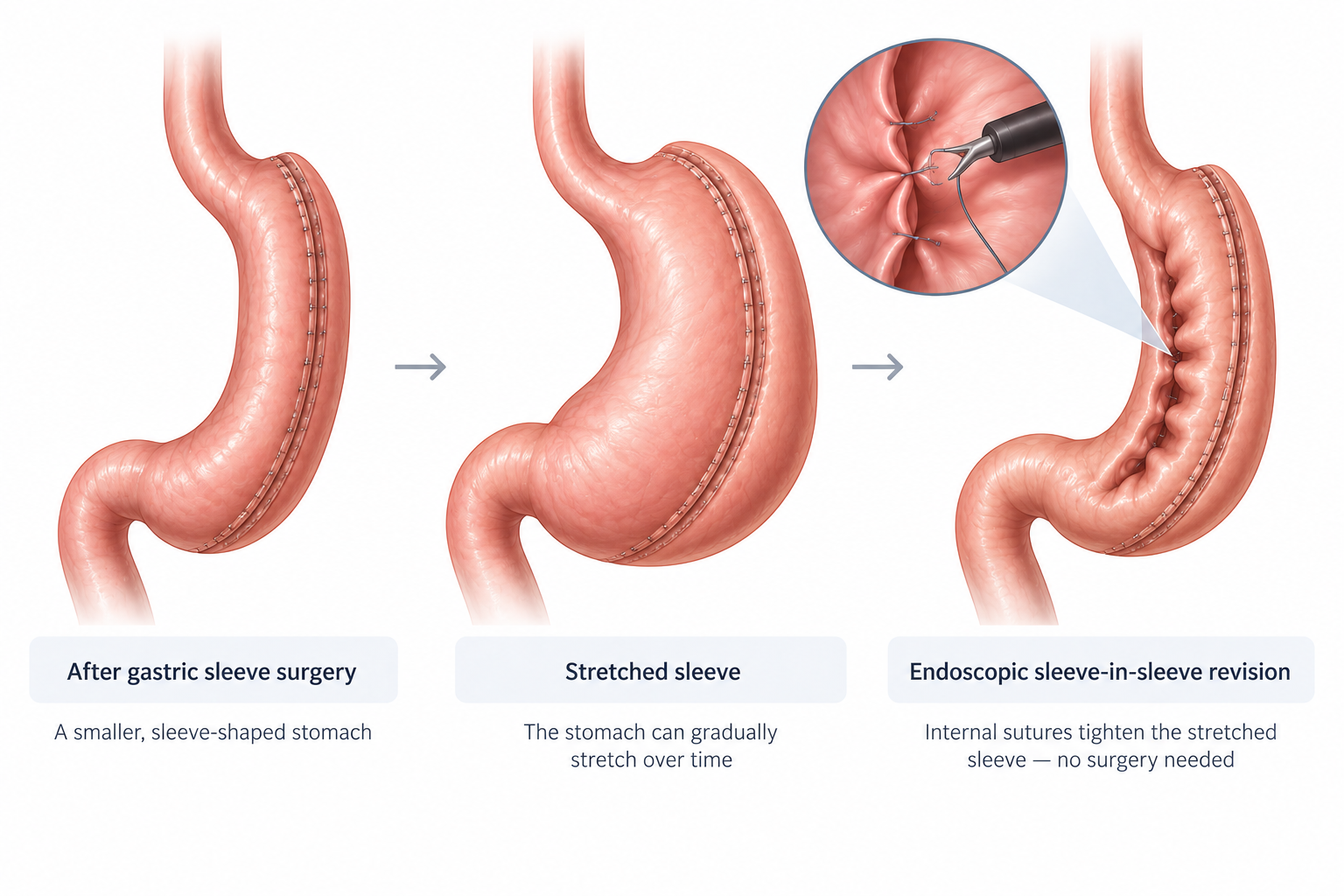
Weight regain after surgery has a next step that doesn’t involve another operation. Source: Everself
ESG vs VSG: Which Is Right for You?
Neither procedure is universally better. As Dr. McGowan, a bariatric endoscopist, frames it, the right choice depends on your goals, medical history, target weight loss, your tolerance for risk, and how you feel about surgery.
The tradeoff is straightforward. VSG offers greater average weight loss and stronger hunger suppression. ESG offers lower procedural risk, faster recovery, a preserved stomach, and much less concern about reflux.
You may lean toward ESG Stomach Tightening® if your BMI sits between 27 and 39, you can’t take a week or more off work, or existing reflux makes surgery risky. Patients who want to keep future options open also tend to choose the endoscopic path.
You may lean toward VSG if your BMI is 40 or higher, you need the largest possible weight loss, or hunger has been your hardest obstacle. Higher BMIs and severe metabolic disease often call for the stronger intervention.
| Helen chose ESG with Everself and lost 63 pounds, about 26% of her body weight, in six months. She missed three days of work for recovery. “The ESG procedure has changed my whole lifestyle; you can do it too,” she says. You can read more patient outcomes on our success stories page. |
|---|
Results differ from person to person. Every figure above reflects what researchers and patients have reported, not what you should expect.
The clearest way to settle this is a conversation with someone who can review your actual numbers. A free consultation with an Everself medical provider covers your eligibility, your options, and what a realistic year ahead looks like. Book your free consultation.
Sources
COMPARING ENDOSCOPIC SLEEVE GASTROPLASTY (ESG) AND LAPAROSCOPIC SLEEVE GASTRECTOMY (LSG) 30-DAY OUTCOMES AND HEALTHCARE UTILIZATION: A MULTI-CENTERED RETROSPECTIVE COHORT STUDY OF 506,597 PATIENTS. (2025). Obesity Surgery. FOUND ON: https://pmc.ncbi.nlm.nih.gov/articles/PMC12129832/
ENDOSCOPIC SLEEVE GASTROPLASTY, LAPAROSCOPIC SLEEVE GASTRECTOMY, AND LAPAROSCOPIC BAND FOR WEIGHT LOSS: HOW DO THEY COMPARE? (2017). Journal of Gastrointestinal Surgery. FOUND ON: https://vivo.weill.cornell.edu/display/pubid29110192
THE EFFECT OF COMBINING SURGICAL OR ENDOSCOPIC BARIATRIC INTERVENTIONS WITH ANTI-OBESITY MEDICATION OR PROBIOTICS ON WEIGHT LOSS: A NARRATIVE REVIEW. (2026). Frontiers in Endocrinology. FOUND ON: https://pmc.ncbi.nlm.nih.gov/articles/PMC12913063/
HOW MUCH DOES GASTRIC SLEEVE SURGERY COST? (2026). Fay Nutrition. FOUND ON: https://www.faynutrition.com/post/gastric-sleeve-surgery-cost-guide-insurance-coverage-financing-options