PCOS and Weight Loss Surgery: Does It Help?
Does weight loss surgery help with PCOS? Learn how bariatric surgery and non-surgical options may affect cycles, fertility, and long-term weight loss
Global leader in endoscopic weight loss, Triple-board-certified in obesity
Many women with PCOS hear the same advice: lose weight, and your symptoms may improve. That advice sounds simple. After years of trying, it rarely feels that way.
You’ve likely tried diets, exercise, and maybe medication. You may have watched the scale drop, then climb back up. The real question feels bigger than a number.
You want to know whether you need weight loss surgery at all. You also want to know what it might actually change.
This article compares bariatric surgery with non-surgical options, including those Everself offers.
Does Weight Loss Help PCOS?
PCOS, weight, and insulin are tightly connected. Many women with PCOS carry some degree of insulin resistance. That means the body needs more insulin to manage blood sugar.
Higher insulin can push the ovaries to make more androgens. Those extra androgens drive familiar symptoms, including irregular periods, acne, and unwanted hair growth. The cycle tends to feed itself.
Losing weight may lower insulin levels. Lower insulin can calm that chain reaction. This is why weight loss sits at the center of most PCOS care.
What changes first?
Even modest weight loss may make a difference. Research suggests that losing 5% to 10% of your body weight may improve PCOS symptoms. You don’t always need a dramatic change to feel one.
The first portion of weight loss often matters most. The earlier in the journey, the more each pound tends to matter.
Insulin resistance, cycle regularity, and androgen symptoms tend to respond first. Still, results vary widely. No two cases of PCOS behave exactly alike.
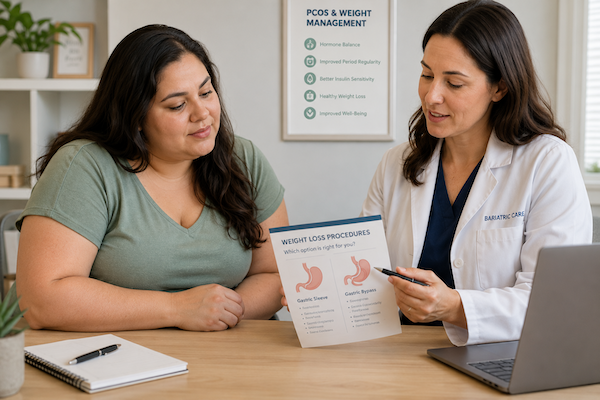
Even a small amount of weight loss may ease common PCOS symptoms.
Does Weight Loss Surgery Help With PCOS?
For many patients, it can. Bariatric surgery leads to large, steady weight loss. That weight loss drives most of the PCOS benefits.
Here’s a nuance that often gets lost. Much of the improvement tracks with how much weight you lose, not the operation itself. A non-surgical path that reaches a similar loss may bring similar gains for some women.
In other words, weight loss is the active ingredient. The method is simply how you get there. That means non-surgical paths are worth taking seriously too.
What the evidence shows
Reviews of bariatric surgery consistently report meaningful improvements in PCOS markers. In one prospective study of 229 women with obesity and PCOS who underwent sleeve gastrectomy, about 79% had their cycles return to a regular pattern within a year, with total weight loss (not starting BMI) being the key driver of that outcome. Studies also report better insulin sensitivity, often appearing within the first three to six months. Androgen levels may also decline, though the extent and timing vary more from person to person.
Some women who struggled to conceive go on to ovulate more often. The research here is encouraging. It is not a guarantee for any one person.
What it does not guarantee
Surgery does not cure PCOS. Different symptoms respond at different rates. Metabolic markers like insulin tend to improve more reliably than hormone levels.
Testosterone and ovarian changes can be slower or smaller. Some women see major shifts. Others notice steadier, quieter progress.
Your outcome depends on your starting health, the procedure, and how much weight you lose. No two women with PCOS respond in exactly the same way.
If pregnancy is part of your plan, timing matters too For women with fertility goals, the months after any weight loss procedure are when ongoing nutrition guidance and regular check-ins matter most, which is exactly what Everself’s 12-month concierge support is designed to cover. During the rapid weight-loss phase after surgery, the body is still changing quickly, so clinicians generally recommend waiting until your weight stabilizes (often around 12 to 18 months) before trying to conceive. A consultation can help you plan around that window.
What Tends to Improve First?
Improvements usually arrive in stages. Some changes show up early. Others take months to settle in.
Early metabolic changes
Metabolic markers often shift first. Insulin sensitivity may improve within weeks of steady weight loss. Blood sugar and energy levels can follow soon after.
These early changes can appear before the scale tells the full story. Many women feel different before they look different. That shift in energy often comes before the scale reflects it.
Cycle and hormone changes
Cycle and hormone changes tend to follow the metabolic ones. Many women notice more regular periods over the next several months. Ovulation may return as hormones rebalance.
Androgen symptoms like acne or excess hair may ease too. These shifts often take longer to appear, and they differ widely from one woman to the next. For some women, returning ovulation reopens the possibility of pregnancy — one of the outcomes many are quietly hoping for when they start asking about weight loss options.
Bariatric Surgery and PCOS
Who may consider surgery
Bariatric surgery tends to suit people who need a larger degree of weight loss, carry a higher BMI, or are managing serious related conditions such as type 2 diabetes or sleep apnea. The two most common procedures, sleeve gastrectomy and gastric bypass, both show meaningful PCOS improvements. Gastric bypass tends to achieve greater total weight loss, while sleeve gastrectomy is the option studied in the BAMBINI trial, the most rigorous randomised controlled trial to date on bariatric surgery and PCOS outcomes.
You can review the main weight loss surgery options before you decide. Each one works differently, and each has its own recovery.
Many women with PCOS try medication first. If you’ve felt stuck, you may relate to not losing weight on semaglutide. Others are left asking: why am I not losing weight on Ozempic.
Tradeoffs to know
Surgery comes with tradeoffs worth weighing. It changes your anatomy, and you usually can’t reverse it. Recovery often takes weeks rather than days.
The incisions can leave small scars. Some patients also adapt to lasting changes in how they eat. Worth knowing before you decide.
The tradeoff is fairly clear. Surgery may offer the strongest weight loss. It is also the most invasive path.
Non-Surgical Options to Consider
You don’t have to choose surgery to make progress. Both ESG Stomach Tightening and the gastric balloon are designed to get you there without it.
If an operation feels like too much, you can explore alternatives to weight loss surgery. Two options tend to fit women with PCOS especially well.
ESG Stomach Tightening
ESG Stomach Tightening® is Everself’s core non-surgical option. It’s a one-time, non-surgical endoscopic procedure that reduces stomach size from the inside. There are no incisions and no scars.
A specialist places sutures through a thin scope, which narrows the stomach. You feel full sooner and eat less over time. Most patients go home the same day.
Clinicians now measure results as total weight loss, or %TWL. It shows the share of your starting weight you lose. This is clearer and fairer than older measures. Studies show an average of about 18% to 20% total weight loss (%TWL), with recovery usually measured in days rather than weeks. The procedure reshapes the stomach without surgery, and the ESG weight loss pros and cons lay out what that tradeoff looks like day to day.
For women with PCOS, that degree of weight loss can translate into the same metabolic and hormonal improvements seen after other methods, including better insulin sensitivity, more regular cycles, and reduced androgen-related symptoms, with faster recovery than traditional surgery.
Gastric balloon
The gastric balloon is a temporary, reversible option. A soft balloon sits in your stomach for about six months, then your care team removes it. It helps you feel full sooner and eat less.
On average, patients lose about 10% to 15% of their total body weight during the six months the balloon is in place. It works best as a jump-start rather than a permanent fix. Many women use that window to build steadier habits.
You can weigh the pros and cons of gastric balloon before you choose.
For women with PCOS who want a lower-commitment entry point, the balloon can still produce meaningful improvements in insulin resistance and cycle health during the six months it is in place.
How Options Compare
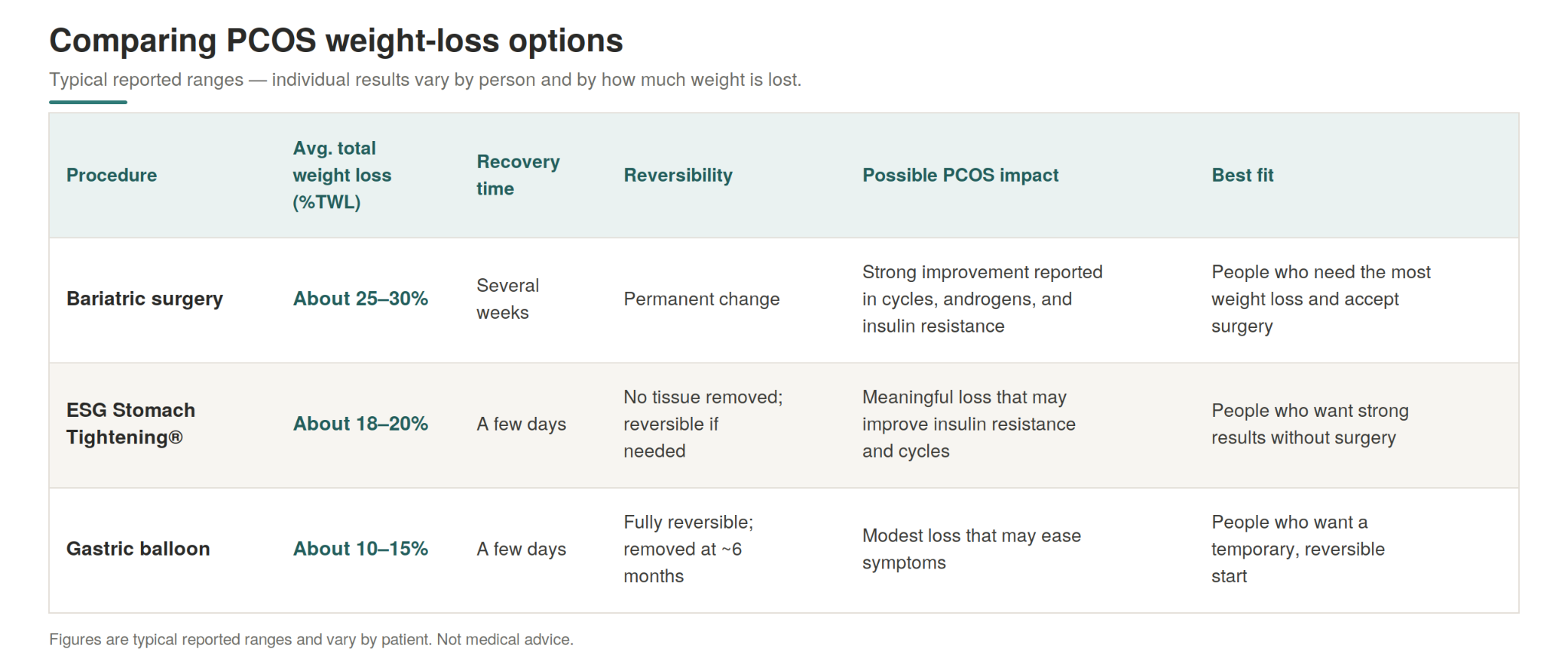
Here’s how the main paths compare for women weighing PCOS and weight loss surgery.
A side-by-side comparison of bariatric surgery, ESG stomach tightening, and gastric balloon procedures, including weight loss, recovery time, reversibility, and potential impact on PCOS symptoms.
What to keep in mind
Each path involves a tradeoff. Bariatric surgery may offer the largest weight loss. It is also the most invasive.
ESG offers meaningful weight loss without surgery. A gastric balloon is a temporary option, and it may suit those who want a reversible option. The right answer depends on your body, not on a ranking.
Who May Be a Candidate?
Factors that matter
Several factors shape the right choice. Your BMI matters most. Everself’s procedures are generally available to people with a BMI over 30, or 27 to 29.9 with a related condition like high blood pressure or diabetes. Medical history and fertility plans matter too.
People who want to avoid an operation often lean toward ESG or a balloon. People who need very large weight loss may consider surgery. Neither choice is better in every case.
The goal is a plan that fits your health and your life. A consultation gives you a clear picture of which option fits where you are right now.
What to Ask Before Deciding
Decision questions
A few clear questions can guide your choice. It helps to bring these to your consultation.
- What amount of total weight loss is realistic for me?
- Which PCOS symptoms am I most likely to improve?
- What does recovery actually look like?
- What follow-up support is included?
- Would a non-surgical option fit my goals better?
If you’re weighing the surgical sleeve against a non-surgical path, compare ESG vs VSG before you decide.
What This Means for You
Weight loss can help PCOS. Surgery helps many women. The method matters less than reaching a meaningful, lasting result.
Everself focuses on less invasive care with personalized support, centering its work on ESG Stomach Tightening® and the gastric balloon. Every procedure comes with 12 months of concierge support.
Our team guides you through each option, so you won’t decide alone. You can take this one clear step at a time.
Discover which weight loss option may fit your PCOS goals and recovery preferences. Start with a consultation and explore ESG Stomach Tightening alongside every option Everself offers - with a care team supporting you for a full year.
Sources
- Samarasinghe SNS, Abbara A, Ortega PM, et al. Ovulatory recovery following weight loss in women with polycystic ovary syndrome and obesity: a post hoc analysis of the BAMBINI randomised controlled trial. Human Reproduction. 2026. PMID: 38491863. Found on: https://pubmed.ncbi.nlm.nih.gov/38491863/
- Park KB, Jun KH. Bariatric surgery for treatment of morbid obesity in adults. Korean Journal of Internal Medicine. 2025;40(1):24–39. PMC12380637. Found on: https://pmc.ncbi.nlm.nih.gov/articles/PMC12380637/