Do I Qualify for Weight Loss Surgery?
Most weight loss surgery requires a BMI of 35-40+. But non-surgical options start at BMI 30. See the full eligibility breakdown and find your fit.

Global leader in endoscopic weight loss, Triple-board-certified in obesity
You’ve probably been asking this question for a while. Maybe a doctor raised it, or maybe you started researching after years of diets that didn’t hold. Here’s the honest answer: qualifying depends on more than your BMI. This guide covers the full picture, including the non-surgical options that most eligibility guides skip.
How Weight Loss Surgery Eligibility Is Determined
- Traditional bariatric surgery generally requires a BMI of 35 or higher under the 2022 ASMBS and IFSO guidelines, or a BMI of 30 to 34.9 with a metabolic condition.
- Non-surgical endoscopic options like ESG Stomach Tightening® and Gastric Balloon can start at a BMI of 30, or 27 to 29.9 with an obesity-related condition.
- Qualifying medically and getting insurance to pay are two separate hurdles, and coverage varies widely by plan.
- ESG currently isn’t covered by insurance, while some commercial plans and Medicare cover bariatric surgery after a lengthy approval process.
- Gastric sleeve and gastric bypass permanently change your anatomy, while ESG and Gastric Balloon don’t.
- A formal consultation, not a BMI chart, is the only way to confirm what you qualify for.
What the Standard Eligibility Criteria for Weight Loss Surgery Look Like
For decades, weight loss surgery followed one main rule. Doctors looked for a BMI of 40 or higher, or a BMI of 35 to 39.9 paired with an obesity-related condition. Those conditions include type 2 diabetes, sleep apnea, high blood pressure, fatty liver disease, and high cholesterol.
Those standards have since changed. In 2022, the American Society for Metabolic and Bariatric Surgery and a global partner group updated the guidelines. They now recommend surgery for anyone with a BMI of 35 or above, regardless of other health conditions.
They also suggest considering surgery for people with a BMI of 30 to 34.9 who have a metabolic disease like type 2 diabetes, particularly when nonsurgical treatment hasn’t produced lasting results. This matters because it gives patients who didn’t qualify under the older rule a real path forward.
Modern guidelines increasingly weigh overall metabolic health and obesity-related complications, not BMI alone. The field is moving toward a fuller view of your health, and that’s good news for patients. Keep in mind that these are clinical guidelines, not a final verdict. Your actual eligibility comes from a formal evaluation with a provider, never from a number by itself.
Why BMI isn’t the only factor in the decision
Providers look well beyond your BMI. They review your obesity-related conditions, your history of past weight loss attempts, and your readiness for change. They also want to see that you can commit to the lifestyle adjustments that follow any procedure.
Some conditions affect whether surgery is safe right now. Active substance use disorders, severe heart disease, and major psychiatric conditions can all play a role. The right move is to discuss your full history openly with a provider. A consultation, not an online quiz, gives you a real answer.
When Surgery May Be Delayed or Reconsidered
Candidacy isn’t always a simple yes or no. For some patients, a few things need attention before surgery moves forward. It doesn’t mean surgery is off the table for good.
Conditions that may affect surgical candidacy
- Untreated substance use disorders usually require a documented period of sobriety before a program approves surgery.
- Uncontrolled psychiatric illness, including active depression, severe anxiety, or an eating disorder, needs stabilization first. This is a clinical safety standard, not a judgment.
- Conditions that raise anesthesia risk, like severe heart or lung disease, may need to be managed before surgery is safe.
- A program will also want to know that you can take part in long-term follow-up, monitoring, and nutritional support.
The reassuring part is that most of these are temporary obstacles you can address, not permanent disqualifications. Providers want to help you reach a point where a procedure is safe and well supported.
Does Insurance Cover Weight Loss Surgery, and What Will It Actually Cost?
Qualifying medically and getting insurance to pay are two different things. Many patients only learn that after they’ve already started the process.
What insurance coverage for bariatric surgery looks like
Many commercial health plans and Medicare do cover bariatric surgery. Coverage still varies a lot by employer, carrier, and plan tier.
Before approving surgery, insurers often require several steps, sometimes spanning three to six months. These commonly include documented prior weight loss attempts, nutrition counseling visits, a psychological evaluation, and formal prior authorization. The psychological evaluation often surprises patients, but it’s a standard, supportive part of the process, not a red flag. It’s simply designed to make sure you have the tools and support system in place to succeed long-term.
One point deserves emphasis. Meeting the medical criteria doesn’t mean your specific plan will cover the procedure. You have to verify coverage with your insurer separately.
The real out-of-pocket picture
Even when a plan covers surgery, you’re usually responsible for deductibles, copays, and coinsurance. Those can add up to thousands of dollars depending on your plan.
Without coverage, self-pay bariatric surgery commonly runs from about $17,000 to $26,000, according to figures cited by the American Society for Metabolic and Bariatric Surgery (ASMBS). Costs climb higher for gastric bypass or in higher-cost regions. This reality leads many qualified patients to look closely at non-surgical options.
Is Bariatric Surgery the Right Choice Even If You Qualify?
Qualifying on paper is one thing. Feeling ready is another. Plenty of patients meet every medical criterion and still have real reservations, and those are worth taking seriously.
- Recovery takes time. Gastric sleeve typically needs 2 to 4 weeks away from normal activity, and gastric bypass often needs longer.
- Any procedure under general anesthesia carries risk. Modern bariatric surgery is safer than many people expect, yet it’s still a major medical event.
- The change is permanent. Gastric sleeve and gastric bypass permanently alter your stomach or digestive tract.
- Monitoring is lifelong. Bariatric surgery patients usually need vitamin and mineral supplements and ongoing checks for nutritional gaps.
None of this means surgery is wrong. For many people, it’s the right call and a safe one. It’s simply worth knowing what you’re signing up for, so you can weigh it against the safest weight loss procedure for your goals.
Explore your non-surgical weight loss options before you commit to anything permanent.
The Weight Requirements Most Guides Don’t Mention
Traditional surgery is not the only medical path, and the non-surgical options have their own criteria. ESG Stomach Tightening® and Gastric Balloon can start at a BMI of 30, or 27 to 29.9 when a related condition is present.
These are the conditions covered earlier, and having one can open eligibility at this lower BMI threshold. Because ESG and Gastric Balloon aren’t surgeries, they carry a different risk and recovery profile entirely.
This lower threshold is directly relevant to four common situations. You may prefer to avoid surgery. You may fall below the BMI cutoff for bariatric surgery. Your insurance may not cover surgery, or the out-of-pocket cost may feel too steep. You may simply want a less-invasive path with a faster recovery.
None of these are edge cases. Together, they describe a large share of the people reading this. It’s worth understanding the full range of weight loss procedure options before you decide.
Who tends to be a strong fit for ESG Stomach Tightening
ESG tends to suit a specific kind of patient. You might be a strong fit if you recognize yourself here.
- You have a BMI in the 30 to 45 range and want meaningful, lasting weight loss without the downtime or permanence of surgery.
- You’ve tried diet, exercise, or medication and haven’t found results that stick.
- You want a one-time, non-surgical procedure rather than an ongoing medication commitment.
ESG Stomach Tightening is a one-time procedure that reshapes the stomach from the inside using sutures, so you feel full sooner. There are no incisions and no scars.
Who tends to be a strong fit for Gastric Balloon
A gastric balloon fits a different set of goals. It works well as a lower-commitment starting point.
- You have a BMI in the 30 to 40 range and want a reversible option, often as a jump-start or milestone.
- You aren’t ready for ESG, or you want to test a non-surgical approach before a longer-term step.
Gastric Balloon is a temporary, six-month procedure, not a permanent change to your body.
A Side-by-Side Look at the Numbers
The table below compares the two main surgeries with the two main non-surgical options.
| Feature | Gastric Bypass | Gastric Sleeve | ESG Stomach Tightening | Gastric Balloon |
|---|---|---|---|---|
| Minimum BMI (general) | 35+, or 30-34.9 with a condition | 35+, or 30-34.9 with a condition | 30+, or 27-29.9 with a condition | 30+, or 27-29.9 with a condition |
| Procedure type | Surgery | Surgery | Non-surgical, endoscopic | Non-surgical, endoscopic |
| Anatomy preserved? | No, tract rerouted | No, part of stomach removed | Yes | Yes |
| Average total weight loss | About 30-35% at 1-2 years (research) | About 25-28% at 1-2 years (research) | About 20% (Everself) | About 10-15% (Everself) |
| Recovery time | 2-4 weeks or more | 2-4 weeks | A few days | A few days |
| Reversible? | No | No | Yes, sutures can be adjusted or removed | Yes, removed at 6 months |
A few things to keep in mind as you read this. Individual results vary widely, so the table is a reference point, not a promise. A provider evaluation is still the right next step.
One note on the numbers. These outcomes use total body weight loss, or %TWL, which reflects the share of your starting weight you lose. It’s the more patient-friendly metric, and it’s what Everself uses instead of excess weight loss. The differences between ESG and gastric sleeve come down to restriction, recovery, and whether the change is permanent.
Compare your options with confidence and find the fit that matches your goals.
What Happens If You Don’t Qualify for Traditional Surgery, or Don’t Want It
Not qualifying for traditional surgery doesn’t mean you’re out of options. The rise of non-surgical endoscopic procedures has opened a real path for people who used to have very little to choose from. That’s especially true if your BMI sits in the 30 to 35 range.
These non-surgical alternatives to bariatric surgery offer meaningful weight loss without the downtime or permanence. They also suit patients who qualify for surgery but would rather avoid it.
At Everself, the difference goes beyond the procedure. Every non-surgical path includes the Everself Program, which is 12 months of concierge care built around you. It means registered dietitian support, nurse practitioner check-ins, and a community that helps your results last.
How to Find Out If You Qualify, Without the Guesswork
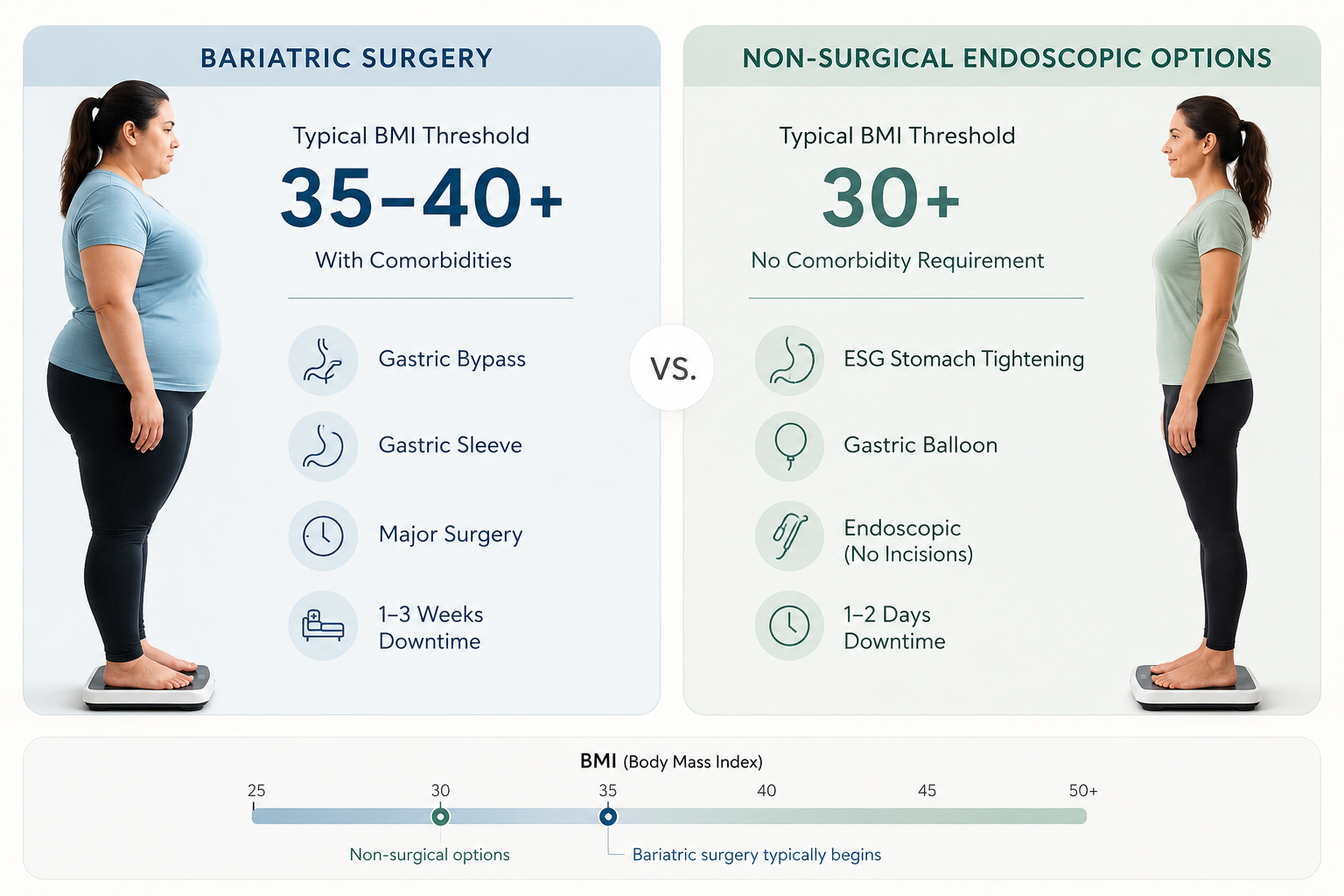
Non-surgical endoscopic options open a medical path at a lower BMI threshold.
BMI opens this conversation, but it doesn’t close it. The updated 2022 ASMBS and IFSO guidelines widened who qualifies for surgery, and non-surgical options widened the picture further.
Between those two shifts, more people qualify for meaningful weight care than they realize. If surgery feels like too much, or if you fall just short of its threshold, a non-surgical path may still fit.
The only way to know for sure is through a formal consultation. A qualified provider reviews your medical history, current health, and goals, then tells you what fits. The National Institute of Diabetes and Digestive and Kidney Diseases outlines the general candidacy factors providers weigh.
A typical evaluation is straightforward. You start with an initial consultation and a conversation about your history and past weight loss attempts. Some bloodwork may follow, along with a discussion about which procedure suits you.
At Everself, that first step is a virtual consultation. You don’t need an in-person visit to get started.
Sources
2022 American Society for Metabolic and Bariatric Surgery (ASMBS) and International Federation for the Surgery of Obesity and Metabolic Disorders (IFSO) Indications for Metabolic and Bariatric Surgery. (2022). Surgery for Obesity and Related Diseases, ASMBS. FOUND ON: https://asmbs.org/resources/scientific-evidence-for-the-updated-guidelines-on-indications-for-metabolic-and-bariatric-surgery-ifso-asmbs/
Potential Candidates for Bariatric Surgery. (2020). National Institute of Diabetes and Digestive and Kidney Diseases. FOUND ON: https://www.niddk.nih.gov/health-information/weight-management/bariatric-surgery/potential-candidates
Park JY. Weight Loss Prediction after Metabolic and Bariatric Surgery. (2023). Journal of Obesity & Metabolic Syndrome, Korean Society for the Study of Obesity. FOUND ON: https://pmc.ncbi.nlm.nih.gov/articles/PMC10088553/