Psychology of Weight Loss Motivation: Why It's So Hard
Struggling to stay motivated to lose weight? Learn the psychology behind it, plus what actually helps motivation stick for the long run.

Global leader in endoscopic weight loss, Triple-board-certified in obesity
You start a new plan feeling ready. The motivation is real, the goals feel reachable, and then, a few weeks in it quietly fades. If that pattern sounds familiar, you haven’t failed, and you’re not lazy.
Losing motivation is a predictable pattern. It comes from a mix of biology, emotion, and willpower that runs thin without support. It isn’t a flaw in your character.
This piece explains why motivation is so hard to hold. It also covers what actually helps it last. You’ll leave with a clearer, kinder way to think about the whole process.
Why Motivation Alone Isn’t Enough - Key Takeaways
- Your body treats calorie restriction as a threat, raising hunger hormones and slowing metabolism to defend your prior weight.
- Motivation naturally rises and dips, so expecting it to stay high every day sets you up to feel like you’re failing.
- Willpower often behaves like a limited daily resource, one that stress, poor sleep, and constant decisions can wear down fast.
- Intrinsic motivation, tied to a personal reason, lasts longer than motivation driven by outside pressure.
- Support predicts consistency, and isolation is one of the strongest predictors of lost motivation.
Why Weight Loss Feels So Mentally Hard
Weight loss motivation fails for structural reasons, not personal ones. Once you see the pattern, it stops feeling like a moral test. The problem was never your character.
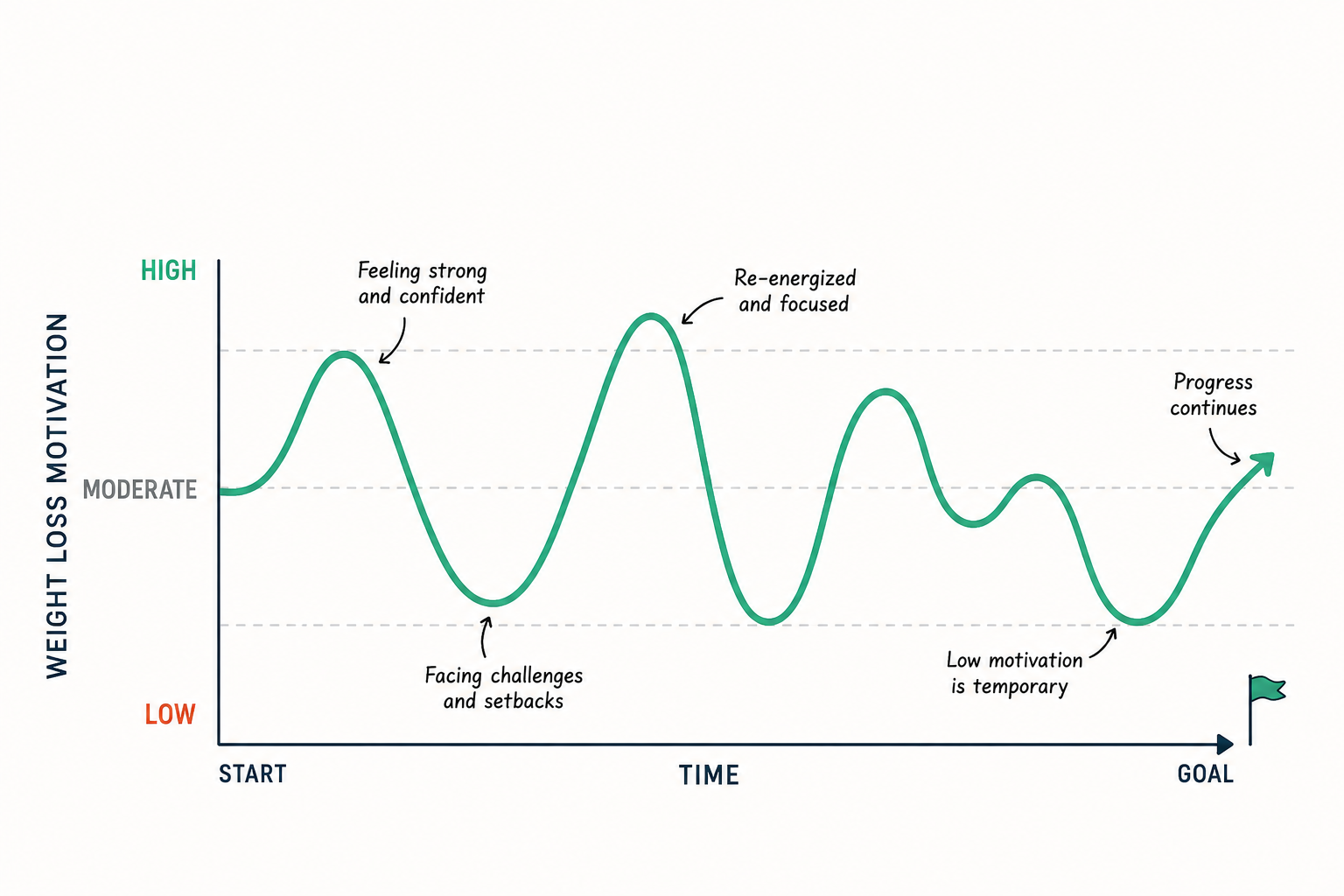
Motivation naturally rises and dips across a weight loss journey, and that rhythm is normal.
Your body resists the change
When you eat less, your body reads it as a threat. It raises hunger hormones like ghrelin and slows your metabolism to protect your prior weight. This is biology working against your effort, not a sign of weak resolve.
Researchers describe this as the body defending a set point. You can push against it, but you’re fighting a system built to keep you where you were. This resistance often grows stronger the longer you’ve carried extra weight.
This is why fast early results tend to slow down. The scale can stall even when you’re doing everything right. Understanding the reasons weight loss stalls can keep a slow phase from feeling like defeat. Newer research adds another layer: fat cells themselves may hold onto a kind of memory of a higher weight even after it’s lost, which is part of why the body seems to keep pushing back long after the diet ends.
Motivation is not linear
Motivation naturally rises and falls. Some days it carries you, and other days it barely shows up. This rhythm is normal, and it doesn’t mean you’ve lost your drive.
The trouble starts when you expect high motivation every day. A low day then feels like proof you’re failing. In reality, you’re just riding a normal dip.
The fix is a plan that still works on the low days. Small habits carry you when the drive goes quiet.
Diet culture sets an unfair bar
Diet culture sells an all-or-nothing story: one off day ruins everything, so people quit after a single slip. This belief does more damage than the slip itself.
A missed workout or an unplanned meal isn’t failure, it’s a normal part of any long effort. Progress is rarely a straight line, and what matters is what you do next.
What Kind of Motivation Actually Lasts
Where your motivation comes from predicts how long it holds. Motivation built on meaning outlasts motivation built on pressure. The source matters more than the intensity.

Motivation built on personal meaning tends to outlast motivation built on outside pressure.
Why willpower alone runs out
Willpower runs on a limited supply, and the day keeps drawing it down. Stress spends it. Bad sleep spends it too. So does every small “should I or shouldn’t I” about food that stacks up between breakfast and dinner. By evening, a lot of people are running on fumes.
That’s why leaning on willpower alone tends to fall apart over time. It asks you to win every little standoff, all day, every day, with nothing held in reserve, and almost no one can keep that going for months.
You’ve probably had an afternoon like this: whatever resolve you woke up with was long gone by the time the hard moment actually showed up. You didn’t get weaker as the day went on. You just ran out of the thing you’ve been spending since morning.
Finding a reason that holds up under pressure
A strong reason keeps you steady when motivation dips. Look for one that’s personal to you, like keeping up with your kids or protecting your health. This kind of internal motivation tends to last.
External pressure works differently. Losing weight to satisfy someone else’s opinion rarely holds up under stress. Research on motivation suggests internal reasons are more durable than outside ones.
Write your reason down where you’ll see it. Return to it on the hard days. A clear “why” often carries you further than a strict plan.
Is this a normal dip, or a sign you need more support?
- Has it lasted more than a few days, not just today?
- Did something specific trigger it, like a plateau, a slip, or a hard week?
- Are you judging yourself harder than the situation actually calls for?
If most of these sound familiar, you’re likely riding a normal dip, not failing. If it’s stretched into weeks with no letup, that’s worth raising with a doctor or your care team.
The Emotional Weight of Weight Loss
Weight loss carries an emotional load that few plans name out loud. This hidden weight often explains why motivation slips. Naming it is the first step to easing it.

Stress and hard emotions shape eating patterns, so naming them helps protect your motivation.
Stress, emotional eating, and the motivation dip
Stress and hard emotions can drive eating that feels outside your control. Food becomes a fast way to soothe a tough moment. This is a coping response, not a lack of discipline.
Naming the pattern helps more than judging it. When you understand the trigger, you can plan a different response. This awareness protects your motivation over time.
Try noticing the feeling before the food. A short pause can reveal what you actually need. Sometimes it’s rest or connection, not a snack.
Plateaus and the fear of failing again
A stalled scale can hit harder than it should. For someone who’s stalled before, a plateau can feel like the start of another failure. The discouragement often outsizes the actual setback.
Plateaus are a normal part of the process, not a verdict. Learning about breaking a weight loss plateau can steady you when progress slows. It also helps to know that weight regain after gastric sleeve has real, addressable causes.
A pause doesn’t erase your progress. Your body is often adjusting to a lower weight. Steady habits usually move the scale again.
Self-doubt after past attempts
Past attempts that didn’t stick leave a mark. You may start a new effort already braced for disappointment. This doubt can quietly undermine your follow-through.
This is common, and it’s worth naming. The emotional side of weight loss surgery shows how tied your feelings are to the process. Self-compassion, not self-criticism, is what helps you keep going.
Your history can not be a prediction. Every past try left you knowing something you didn’t know before: what trips you up, what you reached for when it got hard. A gentler voice in your head is mostly what makes the next attempt one you can actually keep up.
How to Protect Your Motivation Going Forward
You can protect motivation with structure instead of sheer force. A few small shifts make it far more durable. None of them rely on feeling motivated every day.
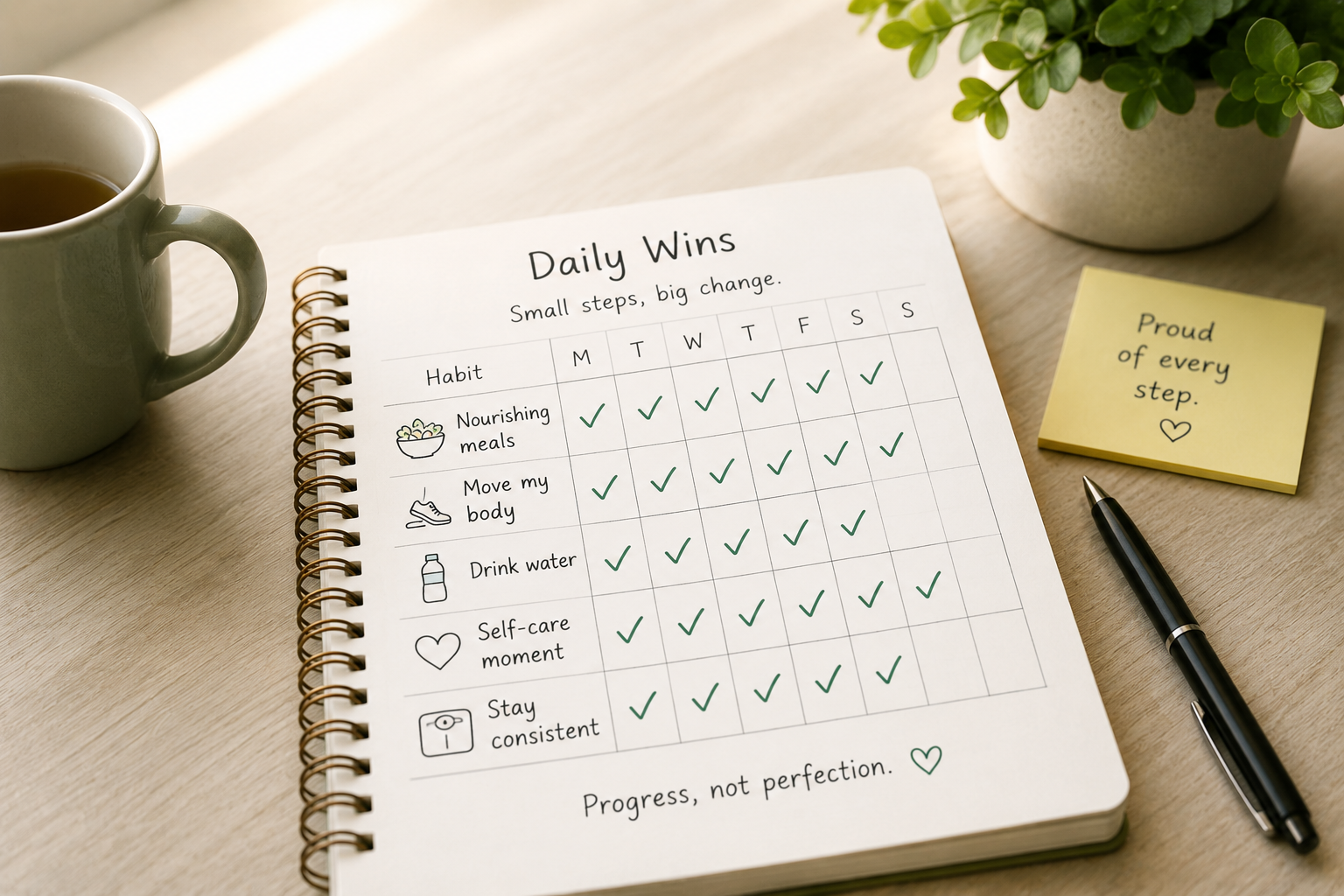
Small, visible wins build the momentum that keeps motivation going.
Set process goals alongside outcome goals
Outcome goals track the scale, and they stall when your body does. Process goals track actions, like meals prepped or workouts finished. These stay in your control even on slow weeks.
Process goals keep you moving when the number won’t budge. They give you a win you can count on. This steady evidence keeps motivation alive.
Aim for goals that live entirely in your control, like finishing a planned workout or prepping tomorrow’s lunch. You decide whether these happen, whether or not your weight cooperates that week.
Build momentum with small, visible wins
Small wins build real momentum. A tracked walk, a protein-first meal, or a full glass of water all count. Each one is proof that you’re doing the work.
This works better than waiting for one big result. Big results are slow, and motivation needs feeding along the way. Guides like how to lose 30 pounds break the goal into steps you can actually see.
Keep the wins visible. Mark them on a calendar or an app. Watching a streak grow makes the next day easier.
Don’t do it without support
Support may matter more than willpower. Research suggests people with social or professional support stay consistent more often than those going it alone. Isolation is one of the strongest predictors of lost motivation.
Support also catches habits before they slide. A coach, a group, or a care team can adjust your plan as your needs change. Plans like how to lose 40 pounds and keep it off tend to hold when that support is built in from the start.
When Motivation Needs More Than Mindset
Sometimes mindset strategies aren’t enough on their own. When biology keeps pushing back, the daily fight gets exhausting. For some people, the starting conditions need to change.
Why removing daily willpower battles matters
For some people, meaningful weight loss needs more than motivation tips. Hunger and portion signals keep working against them, meal after meal. That’s a physical problem, not a discipline problem.
ESG Stomach Tightening® is a one-time, non-surgical endoscopic procedure that reduces stomach size. It changes hunger and portion signals, so you’re not relying on willpower for every meal. This shift removes some of the constant decisions that wear motivation down.
When each meal isn’t a test, motivation lasts longer. You spend less energy resisting and more energy living. The aim is fewer daily battles, not more discipline.
The role of a year of real support
A procedure alone isn’t the whole answer. The Everself Program pairs that physical shift with 12 months of concierge care. Your team includes dietitians and coaches who help build habits that hold.
With this model, motivation and habit-building happen with a team, not alone. You get steady check-ins as your needs change. That’s often where lasting change actually takes hold.
Support like this keeps small stumbles from becoming stalls. Someone helps you adjust before old patterns return. You carry the work, but you don’t carry it by yourself.
A one-time procedure plus a year of support could ease the daily load. You can talk it through before deciding anything. Book your consultation to see whether this path fits you.
Sources
- The biology of weight regulation and the body’s defense of prior weight. NCBI, PMC. Found on: https://www.ncbi.nlm.nih.gov/pmc/articles/PMC12906377/
- Motivation, self-regulation, and adherence in weight management. NCBI, PMC. Found on: https://www.ncbi.nlm.nih.gov/pmc/articles/PMC11026204/
- The role of social and professional support in sustained weight loss. NCBI, PMC. Found on: https://pmc.ncbi.nlm.nih.gov/articles/PMC5421368/