Average Weight Loss with Gastric Sleeve: Timeline & Chart
Gastric sleeve average weight loss timeline & chart: See monthly progress expectations and how results compare with ESG non-surgical weight loss.

Everself Team
Team @ Everself
If you’re researching gastric sleeve, chances are you’re asking how much weight people actually lose, how fast it happens, and what the journey really looks like over time. The internet is full of dramatic before-and-after stories, but they rarely explain what’s typical, what’s variable, and what’s simply not realistic.
This guide breaks down average weight loss with gastric sleeve in a clear, practical way using timelines, charts, and real data to show how results tend to unfold month by month.
Whether you’re worried about plateaus, regain, or how surgical options compare with non-surgical alternatives, the goal here is simple: help you understand what to expect so you can make a decision that fits your body and your life. Let’s get into it.
How Gastric Sleeve Works
Gastric sleeve surgery works by permanently reducing the size of the stomach. During the procedure, about 75–80% of the stomach is removed, leaving a narrow, tube-shaped pouch. This smaller stomach holds far less food, so portion sizes naturally shrink. Most people feel full after a few bites, which lowers calorie intake without relying on extreme dieting.
For patients comparing approaches, understanding ESG (non-surgical) vs VSG (surgical) helps clarify how restriction, recovery, and long-term expectations differ between the two.
Gastric Sleeve Weight Loss Timeline
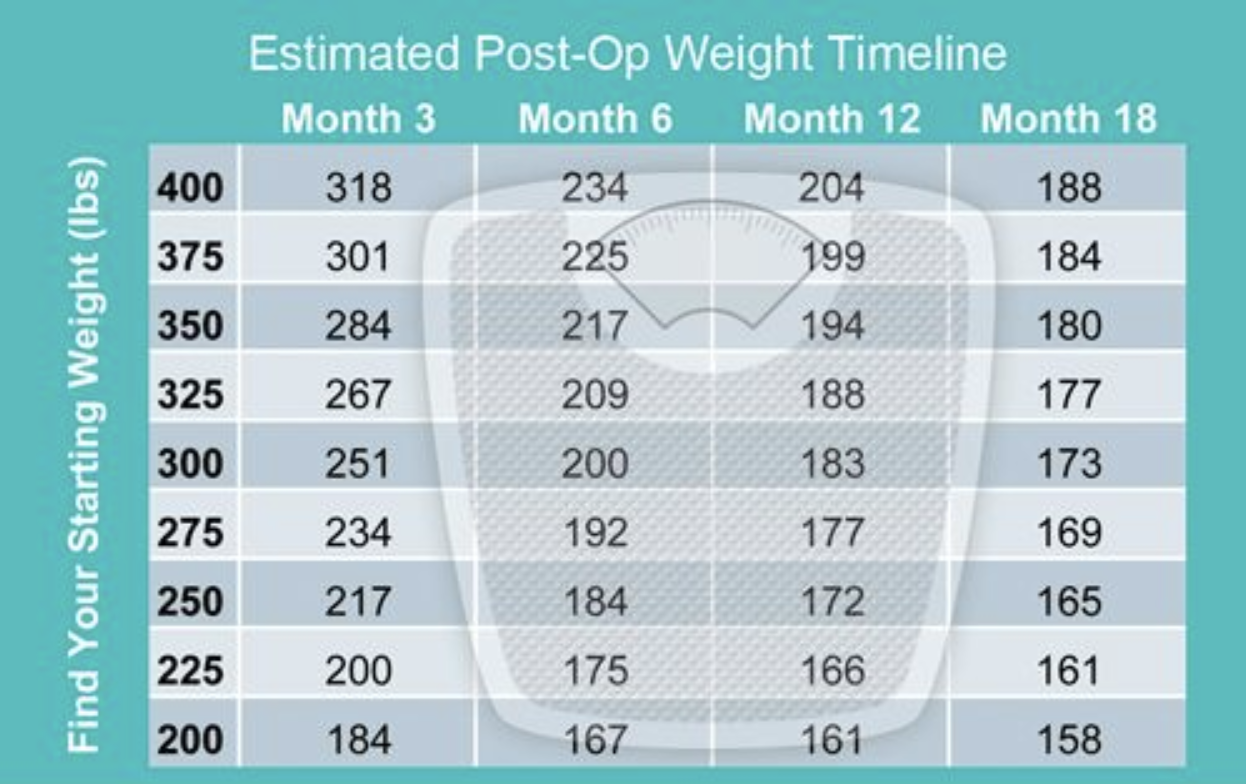
Weight loss after a gastric sleeve doesn’t happen all at once, and understanding the average weight loss with gastric sleeve over time helps set realistic expectations early on. So, let’s break it down:
Caption: Estimated post-op weight timeline showing average expected weight at 3, 6, 12, and 18 months based on starting weight.
Alt text: Estimated gastric sleeve weight loss timeline table showing expected weight at months 3, 6, 12, and 18 by starting weight.
Source: renewbariatrics
First 1–3 Months: Rapid Initial Loss
This is the phase where most people see the scale move quickly. The stomach is healing, portion sizes are very small, and appetite is often noticeably lower. Diet progression from liquids to soft foods plays a big role here for gastric sleeve recovery.
On average, patients lose 20–30% of their total weight loss within the first 3 months, which often translates to 15–25 pounds, depending on starting weight.
4–6 Months: Steady Progress
Gastric sleeve weight loss rate is predictable in months four through six. Metabolism begins adjusting, and hunger cues slowly return, which is normal. This is where habits start to matter more than restriction alone.
Research tracking body composition after the gastric sleeve shows that patients who continue losing weight maintain healthier fat distribution and appetite-related hormone patterns, which is why consistency with protein, hydration, and routine movement becomes more important in this phase.
If weight loss slows slightly here, it usually means your body is stabilizing.
7–12 Months: Plateau & Peak
This phase is often the most emotionally challenging. Weight loss slows, and short plateaus are common as the body adapts to a lower weight. Many patients reach their peak total weight loss between 9 and 12 months, often around 25–35% total body weight loss, which is consistent with outcomes seen across different weight loss surgery options.
Regain risk can creep in here, especially if grazing, liquid calories, or skipped follow-ups enter the picture. This is where refocusing on basics like protein first, structured meals, and routine check-ins can make a real difference.
Long-Term (1+ Years): Maintenance
After the first year, weight loss slows significantly, and long-term outcomes depend less on speed and more on maintaining the average weight loss with gastric sleeve achieved earlier.
A PubMed study of 247 gastric sleeve and bypass patients found that BMI reduction is greatest within the first year after surgery. As weight loss slows and maintenance becomes the focus, concerns about regain are common especially among those who later report gastric sleeve regrets tied to unrealistic expectations or limited long-term support.
Key Metrics Explained
Total Body Weight Loss (TBWL): the metric that matters most
When people talk about “how much weight you’ll lose,” the most useful number to look at is Total Body Weight Loss, often shortened to TBWL. This metric simply shows what percentage of your starting body weight you’ve lost. It’s straightforward, easy to track, and much easier to understand than older methods.
Here’s how it works in real life:
If you start at 220 pounds and lose 40 pounds, your TBWL is about 18%. There’s no guesswork involved, and no assumptions about what your “ideal” weight should be. For most patients, this makes progress feel more tangible and less confusing especially when comparing timelines or spotting plateaus early.
Excess Weight Loss (EWL): why it’s falling out of favor
You may still see Excess Weight Loss mentioned online, but it’s increasingly considered outdated. EWL measures how much weight you’ve lost compared to a calculated “ideal” body weight, which can vary depending on formulas, height charts, or assumptions that don’t reflect real bodies.
For example, two people with the same starting weight can end up with very different EWL percentages even if they lose the same number of pounds. That inconsistency is why many clinicians now prefer TBWL when discussing outcomes and long-term expectations. It keeps the focus on actual progress, not abstract targets.
| Metric | What it measures | How it’s calculated |
|---|---|---|
| Total Body Weight Loss (TBWL) | Percentage of your starting body weight lost | (Weight lost ÷ starting weight) × 100 |
| Excess Weight Loss (EWL) | Weight lost relative to a calculated “ideal” weight | (Weight lost ÷ excess weight) × 100 |
A simple way to think about the difference
If you’re tracking results month by month, TBWL answers the question most people actually care about: How much weight have I lost compared to where I started?
EWL, on the other hand, asks: How close am I to a calculated ideal? For many patients, especially those worried about stalls or regain, that second question creates unnecessary stress.
Gastric Sleeve Weight Loss Chart
The chart below summarizes average weight loss with gastric sleeve across key time periods, alongside comparable data for ESG to show how results differ over time:
| Time Period | Gastric Sleeve Avg TWL | Gastric Sleeve %TWL | ESG Avg TWL | ESG %TWL | Notes / Source |
|---|---|---|---|---|---|
| 1–3 Months | ~15–25 lbs | ~10–15 % | ~10–15 lbs | ~5–9 % | Early loss driven by diet progression; ESG shows more modest early loss. Sleeve gastrectomy shows ~17–30 % TBWL at 12 mo in longer data. |
| 4–6 Months | ~25–40 lbs | ~15–20 % | ~15–25 lbs | ~8–12 % | Intermediate phase as appetite returns; ESG average 10–20 % at 6 –12 mo in existing data. |
| 7–12 Months | ~40–60 lbs | ~20–30 % | ~25–35 lbs | ~10–20 % | Gastric sleeve shows ~29 % TBWL at 12 mo vs ESG ~17–20 % TWL. |
| 1+ Years | ~50–70 lbs | ~22–30 % | ~30–45 lbs | ~15–20 % | Longer trends show gastric sleeve maintains ~22.5 % TWL at 5 yrs. ESG long-term data suggests ~15–20 % TBWL. |
Average Monthly Weight Loss After Gastric Sleeve
Early Months: Higher Monthly Loss, Faster Changes
In the first few months after a gastric sleeve, average monthly weight loss is at its highest. Research consistently shows that most patients lose the largest share of their total weight during this window, largely because intake is tightly controlled and appetite is lower.
Across studies, this phase often looks like:
- Month 1–3: ~8–12 pounds per month on average
This aligns with the chart above, where many patients lose 15–25 pounds within the first 3 months, depending on starting weight.
At this stage, weight loss is driven more by physiology than habits. Portion sizes are very small, calorie intake drops quickly, and early hormonal changes support appetite control. For most people, the scale moving quickly here is expected and temporary.
Mid Phase: Predictable but Slower Monthly Loss
Between months four and six, average monthly weight loss after the gastric sleeve begins to taper, but progress remains steady.
Typical patterns from long-term follow-up data show:
- Month 4–6: ~4–8 pounds per month
This is where many patients land in the range of 1–2 pounds per week, which adds up to another 10–20 pounds over this phase. Hunger cues start to return, and metabolism adjusts to the lower body weight.
At this point, compliance matters more. Protein intake, hydration, meal structure, and routine movement play a bigger role in maintaining a healthy gastric sleeve weight loss rate.
Later Months: Slower Loss and Plateaus Are Normal
From month seven onward, monthly loss slows further, and short plateaus become common. What research and long-term outcome data show:
- Month 7–12: ~2–4 pounds per month on average
Many patients reach their peak total body weight loss between 9 and 12 months, often around 25–35% of their starting weight, depending on BMI and adherence. This is also the phase where the risk of weight regaining increases if habits drift. Grazing, liquid calories, or skipped follow-ups tend to show up here first.
What Influences Monthly Weight Loss Most
- Starting BMI: Higher starting weight often means larger early monthly losses.
- Consistency: Patients who stick to nutrition guidelines see steadier loss as months pass.
- Follow-up care: Regular check-ins help adjust before stalls turn into regain.
Two people can have the same procedure and very different monthly patterns. That’s normal.
A Simple Monthly Weight Loss Example
Here’s how this looks in real numbers. If someone starts at 220 pounds: Losing 18% total body weight equals about 40 pounds. If that loss happens over 12 months, the average comes out to: 40 ÷ 12 ≈ 3–4 pounds per month overall.
That doesn’t mean each month looks the same. Early months might be 8–10 pounds, later months closer to 2–3. The average smooths out those highs and lows
Factors Influencing Your Results
If you’ve ever wondered why two people can follow the same plan and see very different outcomes, the answer usually comes down to a few core habits. These factors determine how well you lose weight, keep it off when progress slows, or plateaus appear.
Diet: the biggest driver of long-term success
If there’s one factor that matters more than all others combined, it’s diet. Long-term weight loss data show that nutrition habits are the strongest predictor of maintenance.
Findings from The American Journal of Clinical Nutrition, which tracks over 4,000 adults who have kept significant weight loss off for more than five years, show that nearly 90% follow consistent dietary patterns, such as controlled calorie intake and structured meals. Exercise plays a supportive role, but on its own, it rarely leads to lasting weight maintenance.
After a gastric sleeve, portion sizes are smaller but food quality still matters. Liquid calories, frequent snacking, and ultra-processed foods can quietly slow progress or trigger stalls. On the flip side, prioritizing protein, eating structured meals, and stopping when you feel satisfied helps protect the weight you’ve already lost.
Exercise: supports loss, protects against regain
Exercise plays a different role than most people expect. It doesn’t drive the biggest drops on the scale early on, but it becomes increasingly important over time.
Movement helps preserve muscle mass, supports metabolism, and improves how your body handles calories as weight loss slows. Even light, consistent activity like walking, resistance training, or low-impact workouts can make plateaus shorter and regain less likely.
Follow-up and support: where stalls get addressed early
Regular follow-up is one of the most overlooked factors influencing results. Patients who stay connected with their care team tend to spot stalls earlier and adjust before regain sets in.
This support is needed for catching habits that creep back in, adjusting nutrition as hunger changes, and managing the emotional side of slower progress. Plateaus are common.
Find the Right Approach to Lasting Weight Loss
Weight loss after a gastric sleeve can look very different from person to person. Your timeline, monthly progress, and even plateaus are shaped by factors like starting weight, nutrition habits, follow-up care, and how your body adapts over time. Rather than chasing a specific number from a chart, the goal is to find an approach that aligns with your health needs, lifestyle, and long-term comfort.
If you’re comparing options or wondering whether a less invasive path could be a better fit, it may help to explore alternatives like ESG stomach tightening alongside gastric sleeve. Book your consultation now.