Is Sono Bello Dangerous? Risks, Reviews & Safer Alternatives
Wondering if Sono Bello is dangerous? Explore liposuction risks, real patient experiences, and non-surgical alternatives like ESG for effective weight loss.


Everself Team
Team @ Everself
Asking “is Sono Bello dangerous?” usually starts with hope. Hope that there’s finally a way to change your body without surgery scars, long recovery, or another round of disappointment after diets and medications didn’t stick.
But once you start researching, that hope often gets mixed with doubt. You see glossy ads promising simplicity. Then you see reviews that tell a very different story. Pain that wasn’t expected. Results that didn’t last. And suddenly the question becomes — is Sono Bello safe for someone like me?
That answer depends on how well the procedure aligns with your body, your health, your expectations, and what support looks like after you’ve paid and gone home.
This guide looks at Sono Bello through that lens so you can decide with clarity instead of pressure.
What Is Sono Bello?
Sono Bello is a body contouring procedure. It removes small pockets of fat from targeted areas like the abdomen, thighs, arms, back, or chin to improve shape and proportions. The treatment is not designed for meaningfull weight loss.
The procedure is typically performed under local anesthesia and uses a thin laser fiber to help break down fat before it is suctioned out. Sono Bello markets this approach as less invasive than traditional liposuction, with smaller incisions and shorter recovery time for many patients.
What Sono Bello is and what it isn’t
This distinction matters for people researching safety and long-term outcomes. Most patients lose only a few pounds on the scale, even when multiple areas are treated through Sono Bello. The goal is visual contouring, not a meaningful reduction in total body weight or long-term metabolic change.
Patients usually start looking for liposuction alternatives when they realize Sono Bello can change how an area looks, but won’t lead to meaningful weight loss or protect them from regaining fat later.
This difference becomes important later when discussing Sono Bello complications and whether results align with what patients are truly looking for.
Who Sono Bello is typically marketed to
Sono Bello generally promotes its procedures to people who:
- Are close to their goal weight
- Have stubborn fat that hasn’t responded to diet or exercise
- Want visible body contouring rather than overall weight reduction
Patients with a higher body mass index or those seeking to lose 30–60 pounds may ultimately need to consider broader weight loss surgery options as they may not see the outcomes they expect, even if the procedure itself goes as planned. This gap between marketing expectations and realistic results is one reason some patients later question whether Sono Bello is safe, appropriate, or worth the cost.
Typical results patients are told to expect
Sono Bello often highlights smoother contours, improved clothing fit, and gradual tightening of the treated area as swelling goes down. However, it’s important to set realistic expectations, especially when weighing possible Sono Bello side effects:
- The scale may change very little
- Results depend heavily on skin elasticity, age, and healing response
- Fat can return in untreated areas if weight is regained.
Potential Risks of Liposuction Like Sono Bello
Before looking at Sono Bello specifically, it helps to understand the broader risks that come with liposuction-based procedures. Let’s break it down:
General risks associated with liposuction procedures
Laser-assisted liposuction, including treatments offered by Sono Bello, is widely performed and generally considered safe when done on carefully selected patients. That said, safe doesn’t mean risk-free. Still, it remains a surgical fat-removal procedure, which means risk can’t be fully eliminated.
Commonly reported issues include swelling, bruising, numbness, fluid buildup, and contour irregularities. These aren’t rare edge cases. They’re known outcomes that surgeons discuss during informed consent.
A systematic review and meta-analysis published by The Aesthetic Society helps put these risks into perspective. The analysis reviewed 39 studies covering 29,368 liposuction patients, with an average age of about 41 and a mean body mass index of 26.4. The findings showed that the overall complication rate was 2.62%. The most common issues included:
- Contour deformity: 2.35%
- Hyperpigmentation: 1.49%
- Seroma (fluid buildup): 0.65%
- Hematoma (bleeding under the skin): 0.27%
- Superficial burns: 0.25%
- Infection: 0.02%
Serious complications such as blood clots, anesthesia toxicity, or skin necrosis were rare, each occurring in well under 0.1% of cases. The takeaway? Liposuction is statistically low-risk for many people, but the most common problems are aesthetic, not medical. Aesthetic complications like these may not be medically dangerous, but they can be distressing, particularly for patients who expected a smooth, predictable cosmetic outcome.
Sono Bello–specific concerns raised by patients
Beyond clinical studies, real-world patient experiences add an important layer to the safety discussion. Investigative reporting by KFF Health News has documented patient allegations involving disfigurement, prolonged pain, scarring, and dissatisfaction following Sono Bello procedures. These reports draw from lawsuits, regulatory complaints, and patient interviews rather than isolated online comments.
It’s important to be clear: many patients report smooth recoveries and acceptable cosmetic results. However, the volume and consistency of complaints highlighted in the investigation raise concerns about outcome variability, patient screening, and expectation-setting, particularly among people who believed the procedure would lead to meaningful weight loss.
Why higher body weight can increase risk
This is where things become especially relevant for sustainable weight loss seekers. Liposuction techniques like Sono Bello are generally studied and optimized in patients with lower to moderate body mass index.
For patients with higher body weight, risks can increase. Healing may be slower. Swelling may last longer. And contour irregularities may be more noticeable. More importantly, removing small amounts of fat does not address the underlying drivers of weight regain, which can lead to frustration when results don’t last.
Patient Reviews and Experiences
When Sono Bello reviews are positive, they tend to follow a clear pattern. Patients who report good experiences usually go in with very specific, cosmetic goals like removing stubborn fat from one area or addressing loose skin after weight loss. On Reddit and review platforms like Trustpilot, satisfied patients often mention:
- Fast procedures with no hospital stay
- Visible fat reduction once swelling subsides
- Being back to light activity or work within a few days
Some also describe feeling reassured by being awake during the procedure or appreciating shorter downtime compared to a traditional tummy tuck. In these cases, expectations were narrow and realistic. Fat removal was the goal.
Where negative experiences consistently show up
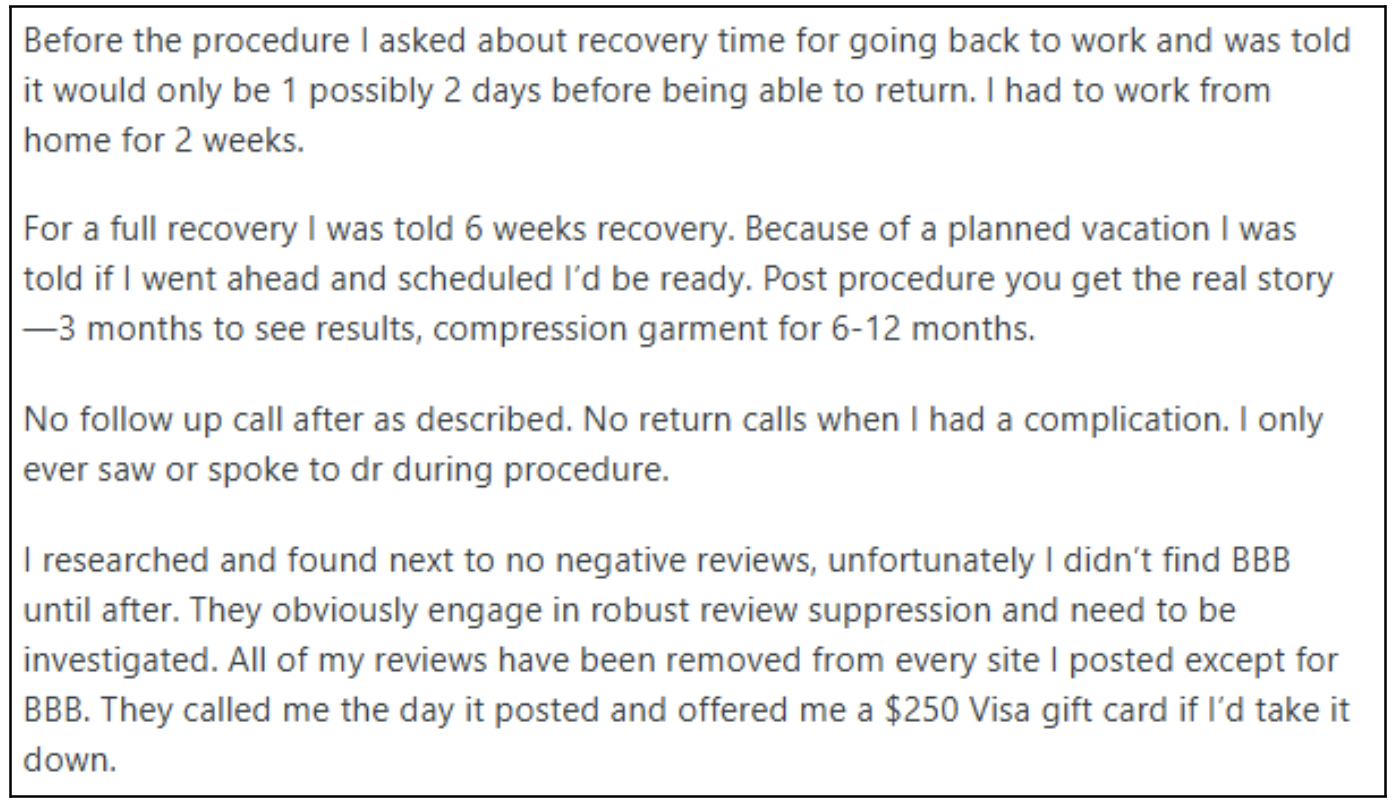
Negative reviews are longer, more detailed, and far more emotionally charged. Across Reddit threads, Trustpilot, and Better Business Bureau complaints, the same issues appear again and again. The most common complaints include:
- Severe pain during the procedure, despite being told that discomfort would be minimal
- Uneven, lumpy, or distorted results that did not improve over time
- Feeling dismissed after surgery, especially when raising concerns or complications
- Limited or inconsistent follow-up care, often handled by staff rather than the surgeon
Several patients describe being awake, crying, or shaking during the procedure while being told they were “maxed out” on medication.
Others report that concerns about symmetry, swelling, or scarring were minimized or labeled as normal healing, sometimes for months.
What average ratings don’t fully capture
Average star ratings can be misleading here. Sono Bello does have positive reviews, but ratings often reflect the consultation experience. Many reviewers who later posted negative outcomes noted that their initial impressions were positive, like friendly staff, polished offices, and reassuring language.
The dissatisfaction tends to emerge weeks or months later, once swelling settles and results become permanent. By then, some patients feel stuck financially and physically, with an outcome they didn’t expect.
Factors Affecting Safety
Surgeon qualifications and experience
With procedures offered by Sono Bello, safety varies greatly based on who performs the procedure. Liposuction is technique-dependent. Surgeons with dedicated cosmetic or plastic surgery training tend to deliver more predictable results and better pain control. Red flags include rushed consultations, unclear credentials, or meeting the surgeon only shortly before the procedure.
Patient health and body profile
Your starting health matters more than ads suggest. Liposuction-style procedures are best suited for people with lower to moderate body weight, good skin elasticity, and no major medical risks.
Higher body weight, smoking history, prior abdominal surgery, or low pain tolerance can increase complications, prolong recovery, or lead to uneven results. Importantly, fat removal does not address metabolism or weight regain.
Facility standards and follow-up care
Safety also depends on where the procedure is done and what happens after. Accredited facilities, consistent staff, and clear post-procedure follow-up reduce risk. Many patient complaints center not on the procedure itself, but on poor aftercare or difficulty reaching providers.
Practical tips for making a safer choice
If you’re considering any cosmetic fat-removal procedure, a few practical steps can reduce risk and regret:
- Ask directly about surgeon’s credentials and verify them independently
- Clarify what the procedure can and cannot do, especially regarding weight loss
- Ask who handles follow-up care and how complications are addressed
- Get more than one consultation, ideally with a board-certified plastic surgeon
- Be cautious of pressure to book quickly or pay in full before meeting the surgeon
Non-Surgical Alternatives for Weight Loss
For people who want real weight loss, non-surgical approaches are becoming more appealing. Unlike liposuction-style procedures that remove small amounts of fat, non-surgical weight loss treatments focus on reducing calorie intake and supporting long-term behavior change without incisions, scars, or long downtime.
Endoscopic weight loss options like ESG
One of the most established non-surgical options is Endoscopic Sleeve Gastroplasty, often referred to as ESG stomach tightening. The procedure is performed through the mouth using an endoscope, so there are no external cuts and no surgical scars. The stomach is reduced in size to help patients feel full sooner and eat less naturally.
Importantly, ESG is not a fringe or experimental approach. It was developed and extensively researched at Harvard Medical School, where early clinical work helped establish its safety profile, technique standards, and long-term weight loss potential. Since then, ESG has been studied across multiple centers and patient populations.
Long-term data helps clarify what patients can realistically expect. In a large single-center study of 1,377 patients followed for up to 6 years, ESG produced an average 21.2% total body weight loss at 1 year and 14.4% total body weight loss at 6 years, showing durability beyond the early weight-loss phase. Importantly, the study reported no mortality, a 0.07% rate of serious bleeding requiring intervention, and a 5.7% revision rate over six years.
Beyond weight loss, patients also saw sustained improvements in obesity-related conditions, including type 2 diabetes, high blood pressure, sleep apnea, and abnormal cholesterol levels. Recovery is typically 2–3 days, with most patients returning to daily routines quickly.
Comparing Approaches
To put expectations side by side, here’s a comparison:
| Feature | Liposuction (e.g., Sono Bello) | Endoscopic Options (ESG) |
|---|---|---|
| Primary goal | Cosmetic contouring | Medical weight loss |
| Average weight loss | ~3–5 lbs | 15–20% total body weight |
| Incisions | Small but present | None |
| Recovery time | Days to weeks | 2–3 days |
| Addresses appetite & metabolism | No | Yes |
Making an Informed Decision
When you’re considering procedures like those offered by Sono Bello, the most important step is asking better questions. A consultation should feel like a medical discussion, not a sales pitch. Some questions worth asking include:
- Who will perform my procedure, and what is their specific training and experience?
- What results can I realistically expect on the scale, not just in the mirror?
- What are the most common reasons patients seek revisions or regret this procedure?
- What does follow-up care look like if I’m unhappy or if something doesn’t feel right?
If answers feel rushed, vague, or overly reassuring, that’s useful information in itself.
Why consultations matter more than ads
Ads focus on best-case outcomes. Consultations reveal fit. This is where you clarify whether a procedure is meant for cosmetic contouring or true weight loss, how long recovery actually takes, and what happens if expectations aren’t met.
Many people benefit from getting more than one opinion, especially when comparing cosmetic procedures with broader weight loss surgery options or non-surgical approaches.
An informed decision is about choosing an approach that matches your goals, health, and comfort level. If your priority is durable, non-surgical weight loss rather than surface-level change, it’s worth exploring alternatives designed specifically for that outcome.
Conclusion
Sono Bello can be safe for the right person, but only when expectations, health, and aftercare are aligned. Understanding the risks, real patient experiences, and how it compares to non-surgical weight loss options helps answer the question is Sono Bello dangerous for your specific goals.
If your priority is losing 30–60 pounds without scars, long downtime, or permanent changes, it’s worth exploring personalized, non-surgical weight loss options designed for durability rather than appearance alone. A medical consultation can help clarify what fits your body, lifestyle, and expectations without pressure to decide before you’re ready.